• Specialist information on
    Powder coating

For decades, electrostatic powder coating has met the highest demands in terms of corrosion protection and decorative colouring.

It is one of the most environmentally friendly painting processes, as no solvents are used throughout the entire process. A professionally applied powder coating significantly increases corrosion protection and offers almost unlimited design possibilities through the choice of colour, surface structure and functional aspects. Can hot-dip galvanised components be powder-coated? And what happens during powder coating? Our Knowledge section provides comprehensive answers to these and other questions relating to corrosion protection.

If you have any further questions, our ZINQ experts will be happy to advise you.
Knowledge about powder coating

Technical basics: Powder coating

The process steps in powder coating Your components undergo the following process steps in our coating plants:

    • Incoming goods inspection
    • Fine plastering of piece galvanised surfaces if necessary
    • Hanging on the product carriers of the automatic conveyor system
    • Preparation (mechanical by blasting (steel) or sweeping (zinc)) or wet-chemical pre-treatment by spraying
    • Drying or tempering the workpieces
    • Electrostatic application of the powder coating
      The fine powdered paint (grain size 10 - 100 µm) is electrostatically charged (30,000 - 100,000 volts) at the spray gun. The charged powder particles follow the electric field lines onto the earthed workpiece and accumulate there with a high degree of deposition. Powder coating that has not reached the workpiece can be recovered and fed back into the cycle. As an option, an epoxy primer can be applied in accordance with the specifications of DIN 55633.
    • Curing the lacquer in the curing oven
      The powder coating melts in the curing oven and forms an even layer. In the case of thermosets, the hardener reacts at a coating-specific temperature and forms a dense, cross-linked coating layer. After typically 15 minutes at 180 °C, the curing process is complete.
    • Final inspection and dispatch
      After the final inspection with regard to visual appearance, layer thickness and adhesive strength, the components are picked, assembled if necessary, packaged and dispatched to the construction site or the end customer on request.

DIN 55633 „Paints and varnishes - Corrosion protection of steel structures by powder coating systems - Evaluation of powder coating systems and execution of the coating“

DIN 55634 „Paints and varnishes - Corrosion protection of load-bearing thin-walled steel components“

DIN EN ISO 12944 „Paints and varnishes - Corrosion protection of steel structures by coating systems“ Note: This standard only describes systems with liquid coating materials (wet paints), but contains the test criteria also used for powder coatings as well as statements on the corrosivity categories

DIN EN 13438 „Paints and varnishes - Powder coatings for galvanised or sherardised steel products for construction purposes“

DIN EN 15773 „Industrial powder coating of hot-dip galvanised and sherardised steel articles (duplex systems) - Specifications, recommendations and guidelines“.

If you require information on the numerous standards that deal with the testing of paint properties and corrosion protection systems, please do not hesitate to contact us.

Choice of material

The powder coating of hot-dip galvanised steel components in accordance with DIN EN ISO 1461 offers the safest way to achieve robust corrosion protection for outdoor components with unrestricted decorative design options.

A high-quality powder coating prevents the zinc layer from being removed. If the paint system is damaged, the underlying zinc layer ensures that the paint is not infiltrated.

This synergy leads to a duration of protection that is far longer than the sum of the individual systems. The basis for optimum powder coating on zinc:

  • The material should be free of white rust, passivation and sealants on delivery
  • To minimise the risk of surface defects (e.g. outgassing), the following limit values must be observed for the steel composition in accordance with DIN EN ISO 14713-2, Table 1:
    • Si ≤ 0.04% and P < 0.02 %, where Si + 2.5 P ≤ 0.09 % or for cold-rolled steels Si + 2.5 P ≤ 0.04 % or
    • 0.14 % to 0.25 % Si. In addition, the aluminium content should not exceed 0.03 %.
  • Zinc coating thicknesses > 150 µm should be avoided, as these have a strong tendency to form outgassing bubbles and often have an uneven surface that cannot usually be completely smoothed by grinding.
  • Ash residues should be removed as soon as possible after galvanising.
  • Fine plastering of the galvanised surface should be carried out in accordance with the instructions under „Additional information > Fine plastering“.

Powder coating of strip galvanised components can be used to achieve visually sophisticated surfaces with very high corrosion protection.

However, the non-galvanised cut edges represent a weak point compared to fully piece-galvanised surfaces, which must be considered separately.

To ensure optimum corrosion protection at the edges as well, these should be rounded before coating and, depending on the expected corrosive stress, additionally primed with an epoxy powder coating if necessary.

The manufacturer often applies a sealant/passivation or even a protective coating to strip galvanised sheet metal. Before powder coating, it is therefore necessary to check whether the layer applied to prevent white rust can lead to adhesion problems. Conventional chemical passivation can usually be easily removed by pickling during pre-treatment at the coating company.

The following quick test is suitable for detecting a possibly interfering protective layer:

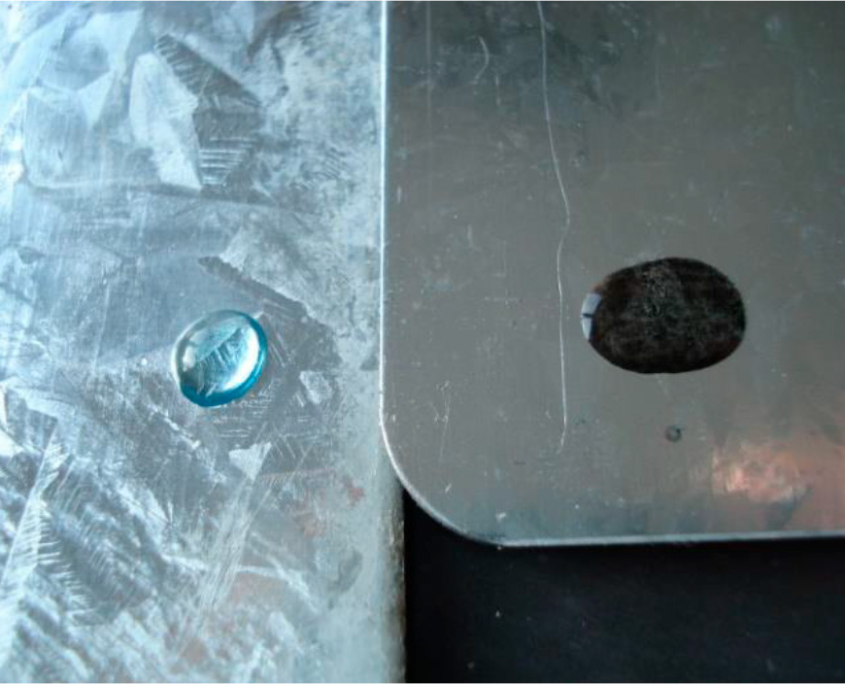
A drop of 4% copper sulphate solution is applied to the strip galvanised surface. If the drop turns black after a few seconds, there is no additional layer on the zinc and powder coating is possible without any problems.

Copper sulphate test (left: not OK/ right: OK)

Electrogalvanised surfaces can be powder-coated with very good results in conjunction with a suitable chemical pre-treatment (e.g. neutral pickling, rinsing, passivation). For this purpose, the material must be delivered free of white rust, as pre-treatment media that could remove the white rust would also damage the very thin zinc layer.

High-quality powder coatings with excellent corrosion protection properties can be achieved on aluminium, particularly in conjunction with chemical pre-treatment. The components should be free of visible oxide deposits on delivery. The effect of heat in the drying and curing oven can lead to distortion of thin-walled aluminium components.

The powder coating on non-galvanised steel is characterised by extremely good adhesive strength and is primarily chosen for indoor use.

To ensure corrosion protection that is suitable for outdoor use without hot-dip galvanising, the following instructions must be observed:

  • mechanical damage leads to corrosion much more quickly, as the protective zinc layer is missing
  • All edges must be rounded
  • Gaps, doublings, unsealed cavities and weld spatter are not permitted
  • Surface condition: - Blasting preparation: Rust is permissible, limited degreasing effect - Chemical pre-treatment: Rust cannot be removed, very good degreasing effect
  • A suspension option must be provided by the customer

With the help of an additional epoxy powder coating primer, corrosion protection on surfaces and edge protection can be significantly improved.

Please also note the information regarding laser edges under „Surface condition on delivery > Laser edges“.

Due to their porosity, cast components can contain gas, which can lead to outgassing during powder coating. In many cases, intensive annealing leads to good results, but we recommend that you first carry out coating tests to determine the achievable quality.

The quality that can be achieved when powder coating stainless steel depends largely on the steel grade and the pre-treatment selected. The desired roughness depth is generally not achieved with blasting, while the pickling attack is often too low with chemical pre-treatment and no conversion layers can form. Coating is therefore carried out under exclusion of any warranty. Preliminary tests are recommended.

The coatability of components that combine different materials (e.g. galvanised surfaces and aluminium) must be agreed with the coating company in advance.

Depending on the pre-treatment/preparation used, not every combination of different substrates can be optimally coated.

Constructive design

All workpieces are suspended from crossbars using hooks or wire for the coating process. As a rule, at least 2 suspension options (holes or eyelets) are required to prevent the components from twisting. To minimise disruptive influences on visible sides, prior consultation with the coating company is recommended.

Both during mechanical preparation by blasting or sweeping and during chemical pre-treatment by spraying, scooping components must be avoided. It is important to ensure that a sufficient number and size of openings are provided to allow the pre-treatment media to drain quickly. You can find information on the insertion of openings in the Knowledge section under Hot-dip galvanising technical information. In contrast to hot-dip galvanising, completely closed hollow bodies can also be powder-coated.

Due to the different materials used for the filler metal and base metal, different reactions can occur between zinc and steel or zinc and the filler metal during hot-dip galvanising. As a result, the weld seam may differ visually from the base material. We recommend the use of welding consumables with a maximum silicon content of 0.45 %. Weld seams with increased zinc build-up should not be ground completely flat, as this would jeopardise the corrosion protection in this area.

Bulky parts can only be coated if they are suspended in the centre and do not exceed the maximum usable dimensions of the respective coating system. You can find the usable dimensions on our ZINQ.com/locations page.

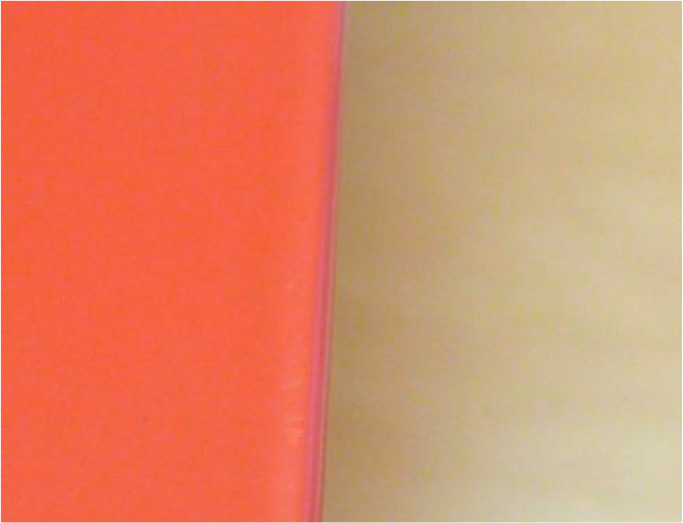
Compared to liquid coating materials, excellent edge protection can be achieved with powder coatings.

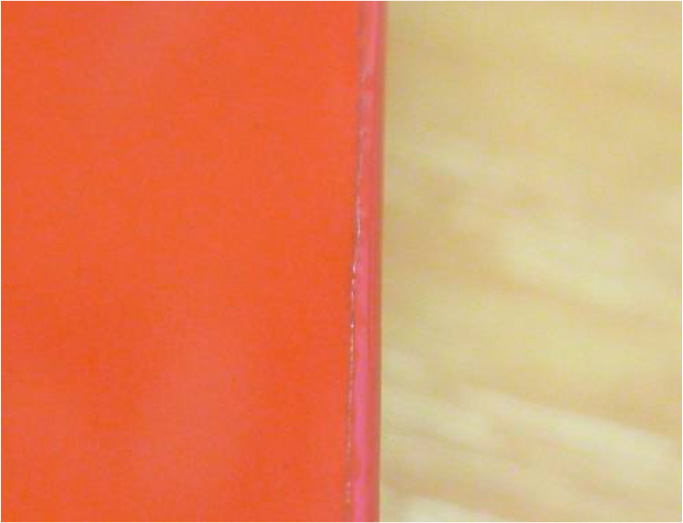
However, on particularly sharp, non-burred/rounded edges (e.g. on perforated or edged sheets and expanded metal), a simple powder coating cannot achieve a sufficient layer thickness.

Sharp edge with insufficient coverage Rounded edge with good edge protection

An additional primer can improve the edge protection here.

In the area of small gaps or doublings, escaping pre-treatment liquid can impair the powder coating surface (in particular bubbly structures, adhesion problems). Depending on the gap, neither the hot-dip galvanising nor the powder coating will close, resulting in a series of open and closed pores that may impair the visual appearance. Corrosion can occur in the gap.

These areas may have to be sealed separately afterwards.

Surfaces of the components to be coated that are difficult to access from the side in the suspended state are not optimally pretreated and often cannot be given an opaque coating.

Due to the electrostatic application of the powder coating, internal corners generally have lower coating thicknesses than freely accessible surfaces. The more acute the internal angle, the higher the probability of not achieving the required powder coating thickness.

Surface condition on delivery

The surface condition of the base material has a significant influence on the quality of the powder coating. To optimise the result, please follow the instructions in the further points under „Surface condition on delivery“.

Stickers and self-adhesive packaging tapes leave residues on the surface that are not removed by the pre-treatment liquids or in the blasting system.

As a result, faulty coatings may occur in these areas if the stickers and any adhesive residues are not removed beforehand. This is the responsibility of the customer.

Residues of liquid coating materials (wet paints), e.g. in corners and gaps of previously painted components, lead to imperfections in the coating due to „boiling“ in the curing oven.

Lettering and markings with waterproof fibre-tip pens (e.g. Edding) are not reliably removed during preparation/treatment. Even if the marking is treated with thinner and sanded beforehand, there is a risk that it will be visible again after coating.

In order to achieve high-quality coatings, rust, scale and mill scale must be removed by blasting, as they can cause unevenness and reduce the adhesive strength. Rolling defects become more prominent through a coating and reduce the visual quality of the coating.

Components that have had the slightest contact with silicone (e.g. through the use of primers) or have been in atmospheres containing silicone can no longer be coated without defects. The slightest contamination with silicone prevents wetting with powder coating and the coating cannot form a closed layer.

Greases and oils in cavities that are not completely welded are liquefied in the ovens and cause areas around the exit point that cannot be wetted with powder coating. The adhesive strength of the paint is also poor in the vicinity of these defects.

When laser cutting in air, a glassy oxide skin forms on the cut surface, which cannot be removed with conventional chemical pre-treatments in powder coating operations. Laser edges produced under the influence of oxygen must be blasted or sanded to ensure good adhesion of the powder coating. Edges lasered under nitrogen are less critical in terms of coatability. In addition, laser edges are usually sharp, so deburring/rounding is advisable before coating.

Even levelling compounds that are offered as „suitable for powder coating“ are generally not suitable for touch-ups on visible surfaces. In most cases, the area treated remains visible after coating.

Scratches caused during sheet metal processing on edge benches, sheet metal shears or by scribing needles, as well as grinding marks, are clearly visible even after coating. Rolling defects can lead to localised thickening (pimples).

As a rule of thumb, unevenness that can be felt with the finger is visible after coating with smooth-running powder coatings.

"Press fleas", which were pressed into the surface during profile production, also form during pre-treatment and in the tempering oven and are clearly visible after coating.

Reworking

Powder coatings can be repaired or painted over with a variety of liquid paints.

The LP10 single-coat 1-component paint available in our factories is suitable for direct use on zinc and powder coating. For the repair of defects on powder-coated steel parts and for the removal of damage to powder coatings caused by grinding or welding and for non-powder-coated add-on parts.

LP-10 is resistant to normal weather influences! The substrate to be painted must be carefully pre-treated or lightly sanded. It is not necessary to apply a primer coat beforehand.

For corrosive loads exceeding C3, we recommend additional priming with epoxy paint.

For the highest demands in terms of colour and gloss retention, 2K PUR lacquers should be used as top coats.

Selection of the coating system

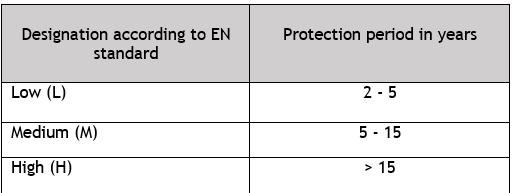
DIN EN ISO 12944-2 defines corrosivity categories for indoor and outdoor applications depending on the ambient conditions. The corrosivity categories C1 to C5-I or C5-M and C-X are defined. The protection period specifies the expected period until the first repair of the corrosion protection system and is categorised as follows:

Please note:

Since 2008, the abbreviations in brackets above have been adapted to the English name.

The old German designations „K“ for „short“ and „L“ for „long“ should no longer be used.

The term of protection is not a warranty period.

If there are particular corrosive loads, we will be happy to help you select the right corrosion protection system.

Important selection criteria are

  • Influence of salt litter or sea salt
  • Moisture load
  • Exposure to chemicals
  • UV radiation

No powder coating systems are defined in the standards for use in soil or water.

Powder coatings consist of binder/resin, hardener, pigment, additives and fillers. They are categorised according to the binder. The following types are commonly used:

Polyester powder coating (SP) Widely used due to the wide range of applications
Epoxy powder coating (EP) Use as a primer or indoors with special chemical stress not UV-resistant
Mixing powder (SP/EP) For special interior applications or as a primer
Polyurethane (PUR) Very good weather and chemical resistance, suitable for anti-graffiti applications
Acrylates High weather resistance, high-quality appearance
Thermoplastics Very good chemical resistance, softer than the chemically curing thermosets mentioned above

Properties of powder coatings

-Gloss levels
dull matt, matt, satin gloss, glossy, high gloss

-Surface structure
Smooth, fine-textured, coarse-textured Note: Textured powder coatings ensure that small material-related imperfections are less noticeable after coating. In addition, fine-textured powder coatings are less prone to the formation of outgassing bubbles

-Functionality
Anti-graffiti, anti-sticker, antibacterial, food-safe, photoluminescent, soft touch

-Weather resistance
standard or highly weather-resistant, i.e. very good gloss and colour retention under weathering and UV exposure (superdurable)

Colours from the RAL Classic range are chosen most frequently. These colours are often in stock in our factories or can be procured within 24 hours. Colours from the RAL Design, NCS, Sikkens, Pantone and other systems are also being used more and more frequently. As a rule, all special colours can also be reproduced using a customer sample. Please contact the factory for minimum order quantities and delivery times.

There are no binding colour templates for the RAL colour shades 9006 and 9007, the DB series and other metallic colour shades. As a result, there are countless products on the market that bear these designations but have very different colour impressions. In order to achieve the best possible colour match if required, we need a colour sample or the name of the powder coating manufacturer and the product number.

However, even when using the same coating, different surface appearances can occur, as these depend on numerous coating parameters such as current, voltage, distance to the workpiece, orientation of the suspended component and curing conditions.

Jobs where colour uniformity is important should therefore be coated in one batch.

Coating application

By providing the following information when placing your order, you can ensure that the coating result meets your requirements:

  • Colour tone, gloss, structure
  • Corrosivity category, protection duration, application according to EN 1090?
  • Visible sides if necessary
  • Are there layer thickness specifications?
  • Should the components be finely plastered?
  • Are there any areas that must not be coated and must be protected from powder coating by masking/taping?
  • Is it an order that requires the same colour as existing components?
Additional notes

For decorative applications, the surface quality of batch galvanised components can be significantly improved by mechanical processing. With fine plastering, unevenness in the zinc coating is reduced by grinding, going beyond the requirements of DIN EN ISO 1461.

Processing must be carried out in such a way that a sufficiently thick layer of zinc remains to ensure permanent corrosion protection. Unless otherwise agreed, weld seams, which are often clearly visible after the galvanising process, are therefore not completely levelled and remain visible even after coating.

Outgassing are bubbles that can occur when the powder coating is cured. If gas escapes from the substrate during the curing process and cannot leave the already cross-linked paint layer in time, visible bubbles and craters remain.

As a rule, these outgassing emissions can be avoided by additionally heating the components to curing temperature before applying the powder coating (tempering) and using suitable powder coatings.

In the case of hot-dip galvanised components on which zinc layer thicknesses > 150 µm have formed due to a steel composition unsuitable for hot-dip galvanising, the risk of outgassing is significantly increased. Likewise, components on which white rust has formed cannot always be coated „bubble-free“.

Some powder coatings in the yellow and orange range have reduced opacity due to the lead-free pigmentation. Even with layer thicknesses of 80 µm, colour shading often occurs.

If this cannot be tolerated, a primer coat of grey or white must be applied.

This applies to RAL:

1003 1004 1016 1018
1021 1023 1028 1032
1033 1034 1037
all 2000's
3002 3020

Subsequent overcoating with powder coating has the following restrictions:

  • Outgassing bubbles can occur when applying the 2nd powder coating layer
  • Re-coating significantly increases the „orange peel“ effect
  • Voltage flashovers can lead to visible „craters“
  • The mechanical properties of a 2-layer powder coating are worse than thinner systems
  • It is advisable to store the components to be overcoated in a warm and dry place for as long as possible before delivery.

Dirt should also be regularly removed from powder coatings in order to maintain the surface in its original quality for a long time.

Cleaning can be carried out with soft cloths and a pH-neutral cleaning agent. Acidic, alkaline and abrasive cleaning agents and solvents can damage the powder coating.

Preliminary tests should be carried out on non-visible surfaces, especially for the more sensitive metallic powder coatings.

Further information on cleaning façades can be found at www.grm-online.de.

Do you have any questions?

Our master locksmiths, steel construction engineers and technicians will be happy to help you - to clarify technical questions, for training in the
corrosion protection, even including support with building inspections.

If required, we will be happy to advise you on site at one of our ZINQ locations or at your company.

Tel. 0800 9403020 info@zinq.com

Search