
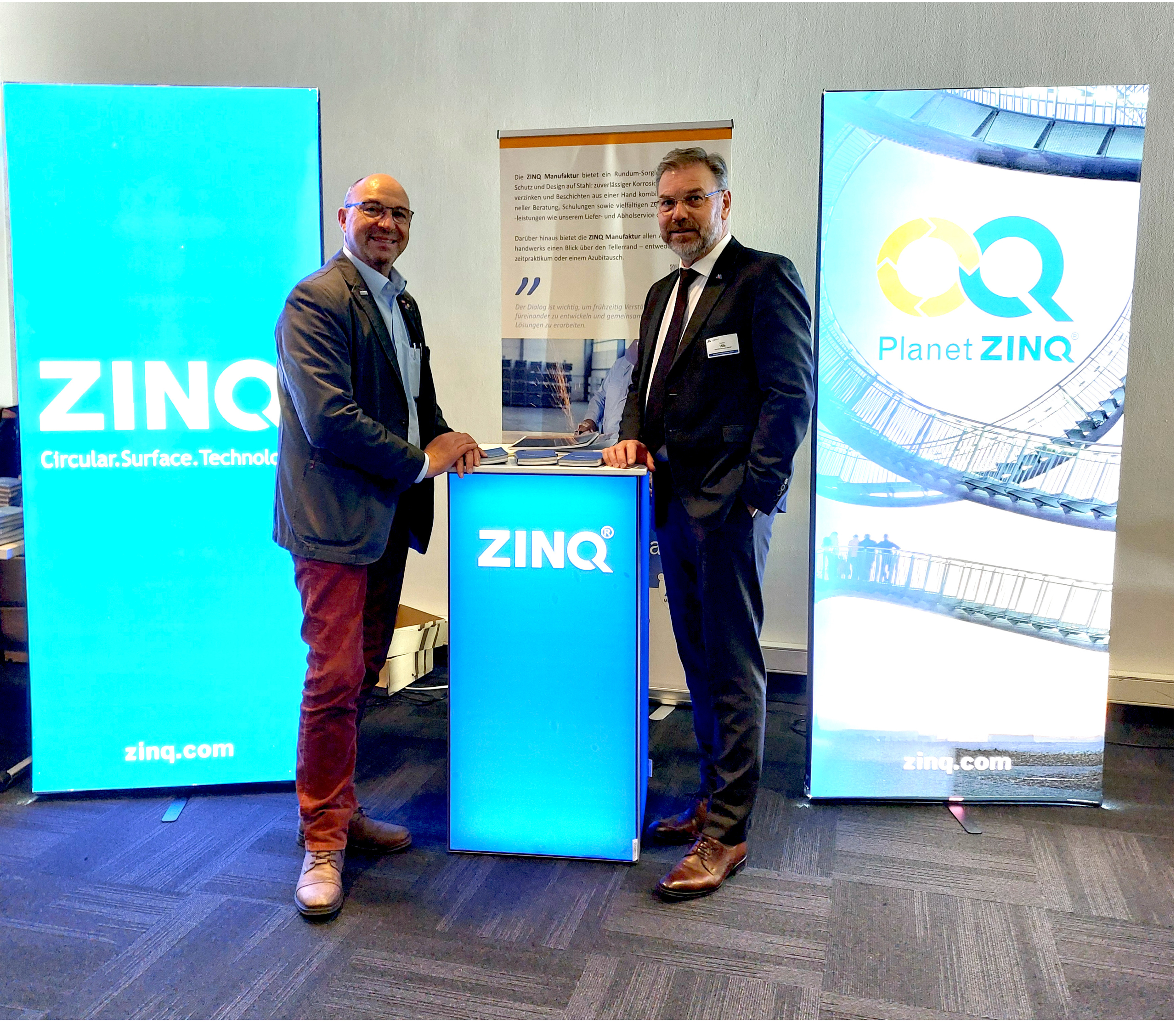
Volker Hastler, Head of ZINQ Manufaktur, in conversation with Diether Hils, Chief Executive of the Federal Association
Metal (BVM).
Mr Hils, many metalworking businesses work alone every day: in the office, on the
Building site, in the workshop. What does a business like that need a bandage for?
Because no single business can tackle all the challenges on its own, nor should it have to. Just think of ongoing issues such as skills shortages, rising energy and material costs, as well as growing demands in terms of sustainability and digitalisation. This can easily overwhelm an individual business. This is precisely where the association comes in
into play. Within our guilds and regional associations, businesses exchange views with colleagues, develop solutions together and benefit from the pooled knowledge of many experts. At the same time, the BVM is also a bridge to partners from business, politics and science. Anyone who uses such a network undoubtedly has advantages.
Climate action, circular economy, new materials: Does that sound to you like a
doesn't a small craft business look for extra effort rather than opportunity?
I well understand why many perceive the transformation at first glance as an additional burden. But precisely for that reason it is important to me to make clear that it can also be grasped as an opportunity. Whoever understands early on what sustainable production, new materials or innovative processes mean for their everyday work secures competitive advantages. Metal can indeed become a permanent raw material reservoir if we design products in such a way that at the end of their life they are not disposed of, but are fed back into the cycle as metal. That is not a dream of the future, that is already possible today. Metal is a material that, with suitable sorting and processing, can be fed back into the cycle again and again – and thus, particularly in the metalworking trade, is a strong argument for sustainability.
Training positions remain vacant. What can a company together
achieve with others what he cannot achieve alone?
Recruitment of young talent works best today when all stakeholders pull together: businesses, trade guilds, associations, schools and partners from the business community. „Let's play Metall“ is the young talent campaign through which targeted career guidance related to the metal crafts professions is jointly shaped. Career guidance ambassadors organise measures nationwide to inspire pupils, parents and teachers with the appeal of metal-working professions. Career opportunities within the sector are also highlighted in the process. Modern training opportunities, working with metals that play a role in climate protection, and innovative technologies: these are messages that need to be communicated more widely. Partnerships can be of great help here. An individual business does not have the reach that a network has.
What does a metal engineering business actually get out of its trade association cooperating with
partnering with a surface specialist like ZINQ?
Corrosion protection is an important issue for metal-working businesses technically, economically and also from a sustainability perspective. ZINQ contributes its expertise in the field of surface finishing and drives topics such as circular thinking and circular product design. A metal worker who understands which galvanising processes are suitable for which requirements, what possibilities exist for pre- and post-treatment – for example with ZINQ add-on products – and how to argue this to their customer has an advantage. Precisely that is also a benefit of such partnerships.
Mr Hils, you have been Chief Executive of the BVM since April 2025. You
have known metal craft for decades from vocational education.
What do you want to tackle and what will you tackle in the near future?
Over the past almost two decades, I have been particularly committed to vocational education and training and attracting new talent, as previously outlined. The topic remains very important to me. Without well-trained skilled workers, there is no metalworking trade! Following the restructuring of the master craftsman examination regulations, the next task is to reorganise the training occupations in the metalworking trade. Another important challenge is to realign the Federal Association, taking into account local guilds, state associations and our cooperation partners. Digital formats and the contemporary integration of young members are the focus of our press and public relations work. In the field of technology, the challenge is that we in the
advocate for SME-friendly standardisation within the framework of German and European standardisation procedures. At the same time, I would like to further develop cooperation with partner companies. Knowledge and innovations should reach businesses even faster and more directly. And I would like to address central political topics and demands through our members in the regions throughout Germany, thereby sharpening the profile of the metalworking trade in the public eye so that our industry receives the political attention it deserves.
How important will partnerships be for the metalworking trade in the
coming years be?
Probably even more important than today. The challenges such as digitalisation, sustainability, skilled workers and economic conditions are too complex for lone fighters. The businesses that will be successful are those that are open to cooperation and actively use networks. This applies to individual businesses just as much as to organisations such as the Federal Association of Metal (Bundesverband Metall). Those who pool expertise and work together on solutions are not only well positioned today, but will also have a strong position tomorrow.


 Deutsch
  English (UK)
  Polski
  Nederlands (België)
  Français de Belgique