
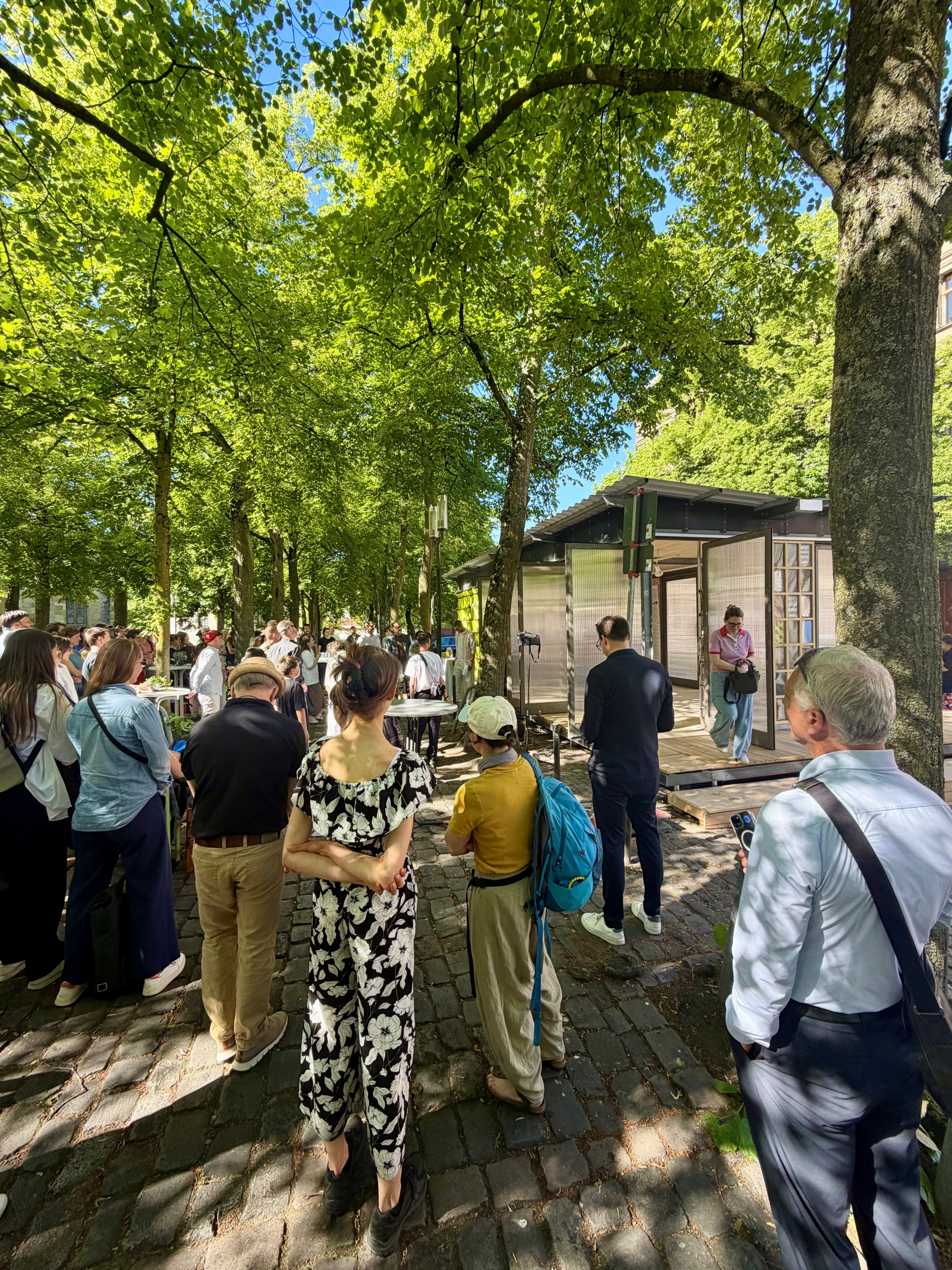
Since the end of May, a different kind of pavilion has stood on the cathedral square in Münster. The „kreisl Kiste“ consists of used materials, was designed for dismantling right from the start, and is to be rebuilt in a new location after its time in Münster. ZINQ also contributed to this: the steel profiles for the floor grid came from previous use, were galvanised in Essen, where they were degalvanised, adjusted and hot-dip galvanised again with ecoZINQ.
A pavilion made from what is already there
Behind the kreisl Kiste stands Münster University of Applied Sciences. The project was initiated by Master's students Sophie Weber and Laura Krieger and supported by the Chair of Circular Construction held by Prof. Dr.-Ing. Anja Rosen at the Münster School of Architecture. Research, planning, craftsmanship and industry have come together here to build a real-world laboratory that makes the circular economy tangible. The kreisl Kiste sees itself as an experimental space: in the coming months, it will be used to jointly test what more resource-efficient building and business can look like.
De-zincified, adjusted and re-galvanised
The Kreisl Kiste thrives on the principle of reuse: for example, the windows come from a school, and the facade was made from decommissioned LCD screens and old fire hoses, among other things. The steel profiles for the floor also came from previous use. At the ZINQ site in Essen, the existing zinc coating was first removed, then new sleeves were welded on and the profiles were finally hot-dip galvanised again with ecoZINQ. No new material, no loss of quality. Thus protected against corrosion in the best possible way, the steel profiles were ready for their next deployment in Münster.
Planet ZINQ, the circular business model
The project aligns with the concept of circularity that the surface specialist ZINQ has embedded in its business model Planet ZINQ. ZINQ surfaces are designed to protect steel for decades (slow the loop) and to be reused without any loss of quality at the end of a product's life (close the loop). All R strategies intertwine: from reuse, repair and refurbish to recycle, as well as re-design and re-place. The kreisl box is a tangible example of this.
Over the coming months, the kreisl Kiste can be experienced on the Domplatz in Münster as a public exhibition and event venue dedicated to circular value creation. Alongside workshops, lectures and panel discussions on topics such as sustainable construction and circular value creation, the kreisl Kiste is intended to be above all one thing: an open space where people can come together to talk.





 ZINQ_Gerd_Kaemper
 Deutsch
  English (UK)
  Polski
  Nederlands (België)
  Français de Belgique