
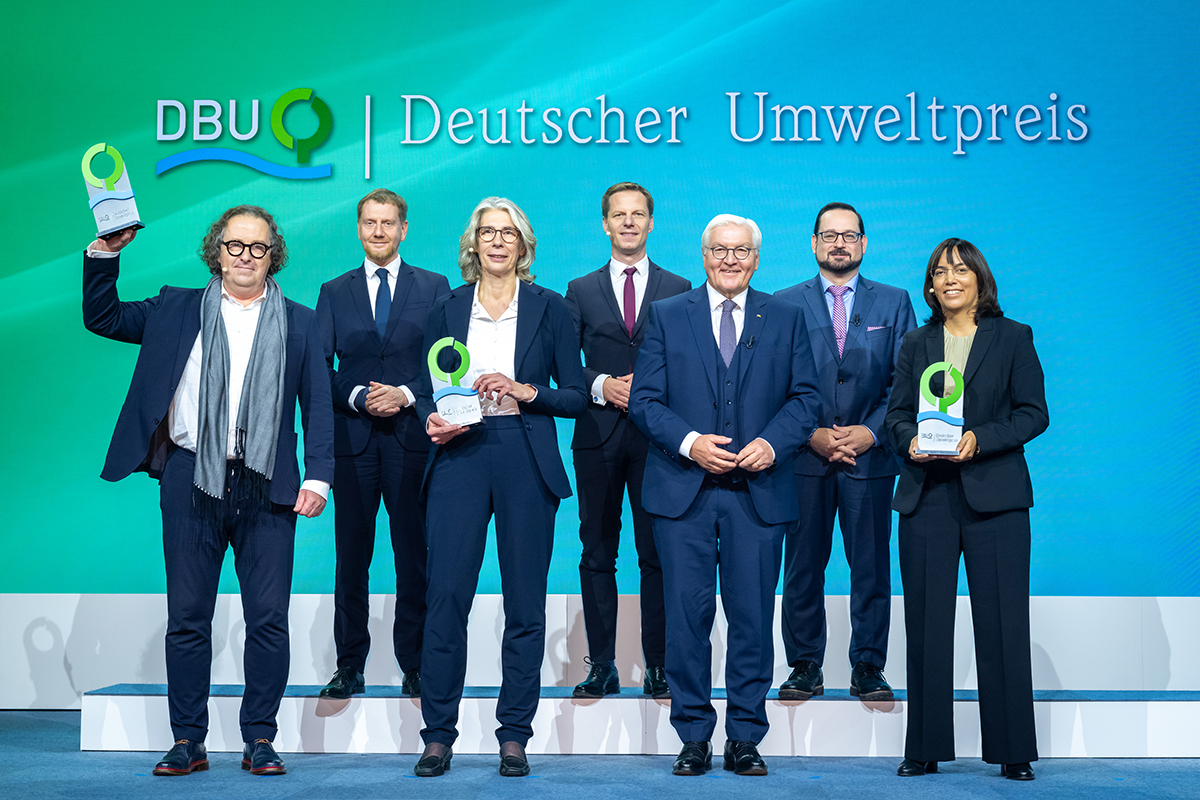
„At ZINQ in Gelsenkirchen, the company is so successfully committed to resource-conserving and therefore climate-friendly sustainable technology that it has... brought it to market leadership,“ said Federal President Frank-Walter Steinmeier.
The circular business model Planet ZINQ shows that energy- and resource-intensive companies can transform their production and products towards a circular economy and thereby reduce emissions and resource consumption.
The goal is triple-zero quality products – zero CO₂ emissions, zero waste, and zero pollution. The measures developed for this purpose are based on standardised, freely available standards and are transferable to other companies and industries due to their modular design.
The cornerstone and, at the same time, the origin of Planet ZINQ is thinking in terms of cycles based on the Cradle-to-Cradle principle. To this end, ZINQ relies on circular product design based on three central principles of the R-strategies: Design the loop, Slow the loop and Close the loop. In this way, products are developed using materials that are safe for human health, their service life is extended, and all materials are continuously returned
to the cycle
Through the sustainable innovations developed at the ZINQ Futurium research and development centre in Gelsenkirchen, ZINQ creates surfaces that are safe for human health, conserve resources, extend the service life of steel products and can be fully returned to the cycle.
Prize money to go towards research and projects
The prize money from the German Environmental Prize will be fully invested in scientific research and projects that further advance the path towards a climate-neutral circular economy. Two studies are planned: one will analyse the current situation from a technical perspective and outline necessary steps, while the other will focus on the economic evaluation of circular product quality. The aim is to strengthen the competitiveness of circular products and create leading markets where sustainable decisions are also economically attractive. Digital product passes play a central role in this, as they make ecological properties measurable and visible.


 Pöhnert/Chamber of Commerce and Industry
 Deutsch
  English (UK)
  Polski
  Nederlands (België)
  Français de Belgique