
In the presence of NRW Environment Minister Johannes Remmel, Voigt & Schweitzer, along with a total of 200 invited guests, will inaugurate the new microZINQ® capacity in Hagen on 3 September 2015.
This means the multi-award-winning microZINQ® piece galvanising process is now entering regular full operation and will secure entirely new fields of application and sales markets. This was preceded not only by intensive fundamental development with a cooperative partner but also by its inclusion in the NRW state government's Resource Efficiency Programme in 2012.
microZINQ® uses 80 per cent less zinc and up to 50 per cent less gas than conventional galvanising. The technological innovation saves up to 500 tonnes of zinc per year. Due to the lower gas consumption and the elimination of transport, CO₂ emissions can be reduced by approx. 2,000 tonnes a year. Managing partner Lars Baumgürtel thanks his employees and cooperation partners, but in particular the state government of North Rhine-Westphalia. Thanks to financial grants from the public sector, the multi-million-euro project, including the new building and plant technology, was able to be realised from an innovation into a commercially viable process.
Hagen, 7 September 2015
North Rhine-Westphalia is making literal headway, piece by piece, on the path to resource efficiency.
Galvanising specialist Voigt & Schweitzer opened its new micro-galvanising plant in Hagen with 200 invited guests from politics, business and industry, in the presence of Environment Minister Johannes Remmel. A moderated expert discussion between scientists, association representatives, the entrepreneur and the funding body on the renowned „Blue Sofa“ on the topic of „Resource efficiency and innovations in the metal industry“ offered guests insights into a current and important issue. The panel agreed that efficient resource management, on the one hand, ensures the profitability and thus the competitiveness of companies.
At the same time, resource efficiency is also a key issue in terms of environmental protection. The discussion focused on what additional contribution innovative products can make and how to stimulate increased innovation activity in the country.
A live galvanising demonstration with guided tours of the factory and exhibition by company staff, followed by a traditional get-together, concluded the event.
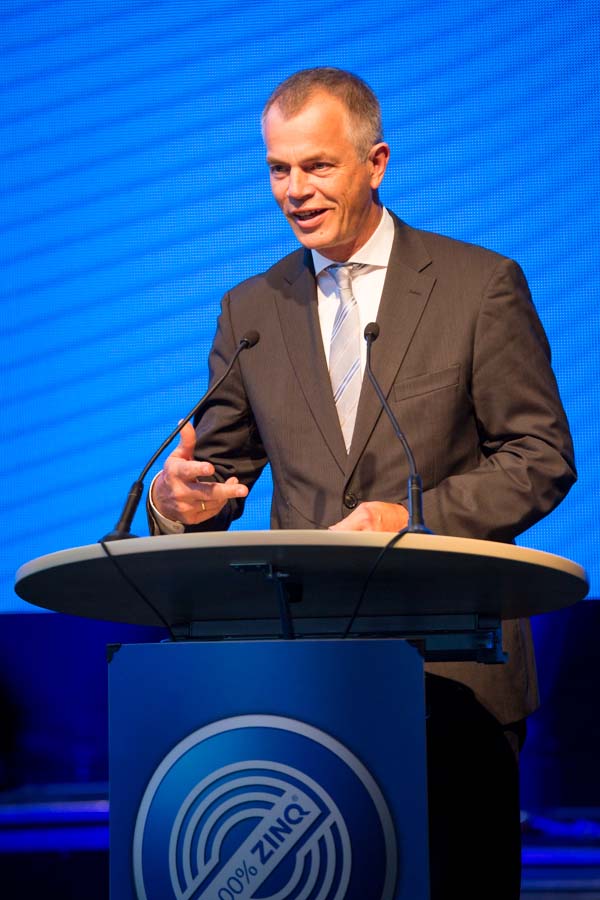
In his speech at the company opening, NRW Environment Minister Johannes Remmel said:
„Given that material costs in trade account for 45 percent, a saving of 80 percent is tremendous.“ Efficiency could improve the economic situation and thus competitiveness. The drivers are small and medium-sized enterprises. „Voigt & Schweitzer is a face of the industrial future,“ said Environment Minister Remmel.
This has already begun. With the expansion of its microZINQ® capacities, the company Voigt & Schweitzer is serving a growing market for resource-efficient and durable corrosion protection. However, the capacity expansion is not solely the work of the entrepreneur: the project was funded by the European Union from the European Regional Development Fund. The traditional company applied for funding of €1.7 million. In total, Voigt & Schweitzer has invested €8 million in the capacity expansion and securing the Hagen site.
„Customers are increasingly demanding durable and thinly galvanised surfaces with consistent corrosion protection,“ says Lars Baumgürtel, managing partner of Voigt & Schweitzer.
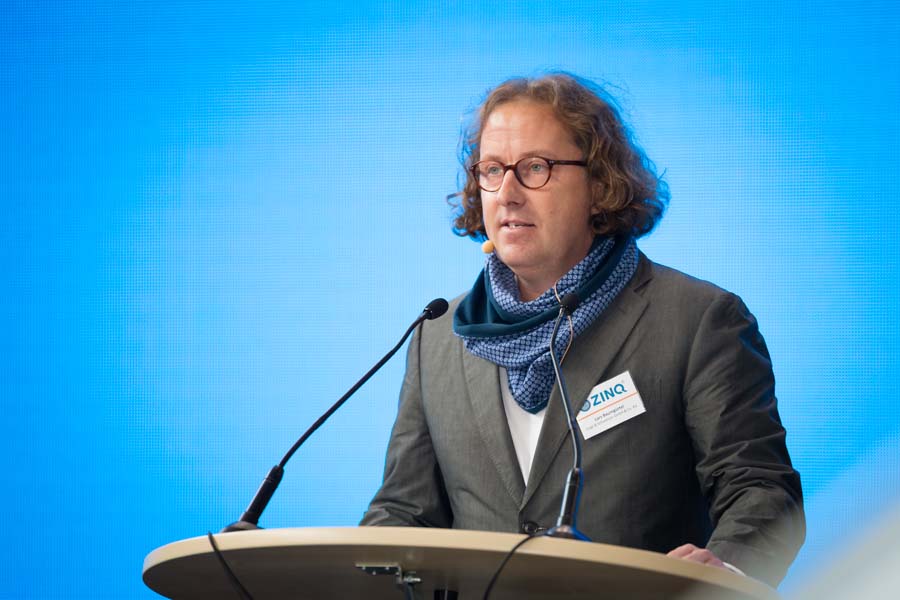
His company has developed it: the innovative piece galvanising process is called microZINQ®. microZINQ® was adapted by Voigt & Schweitzer from strip galvanising to piece galvanising in collaboration with the automotive industry. In recent years, it has received numerous awards for its functional properties, its outstanding appearance and, in particular, its remarkable potential for reducing zinc consumption and energy use. With this innovative process, the galvanising specialist from Gelsenkirchen achieved a first in the industry: for the first time, corrosion protection was improved whilst using less zinc. Longer durability with a thinner coating. Thick coatings are a thing of the past; the „age-old“ technology of hot-dip galvanising has thus been optimised and made fit for the future. There is considerable market interest in high-performance corrosion protection systems, particularly in the field of small components. The reason for this is the need for a good fit and the maintenance of tight tolerances; in other words, due to the geometry and design of small components, corrosion protection cannot be applied arbitrarily, making thin coatings essential. In direct comparison, conventional hot-dip galvanising results in a coating thickness of 80 to 100 µm. microZINQ® produces a coating thickness of just 10 to 15 µm. (For clarification: 1 mm = 1000 µm / 1 µm = 0.001 mm)
The existing 4-metre bath was designed for galvanising an undercarriage component and was technically unable to meet market demands. By expanding the facility to include a centrifugal and rack dipping area, Voigt & Schweitzer is providing more space for efficient and effective corrosion protection. Steel can be accommodated in tonnes in the seven-metre long, 3.20-metre deep and almost two-metre wide bath. The zinc kettle holds approximately 250 tonnes of liquid zinc-aluminium alloy, with an annual capacity for 15,000 tonnes of steel to be galvanised. Finally, other industries can also benefit from the new piece galvanising technology. Customers from the agricultural machinery and commercial vehicle, steel construction, and transport and energy sectors are already waiting for the new capacity to become available and to be filled.
Securing jobs in Hagen: Galvanising has been carried out at the Hagen site since 1912. In 1986, the plant was taken over by Voigt & Schweitzer. The first test series with microZINQ® began in 2003. The process was tested in over 3,000 trials. In the summer of 2015, microZINQ® also received general building supervisory approval (AbZ) from the German Institute for Construction Technology (DIBt). The new microZINQ® galvanising plant will secure 20 jobs in Hagen. A small ray of hope in the hard-hit city of Hagen: In Hagen, a total of 10,000 jobs in the metal industry have been lost since the closure of the Jasper mine in the 1970s.



 Deutsch
  English (UK)
  Polski
  Nederlands (België)
  Français de Belgique