
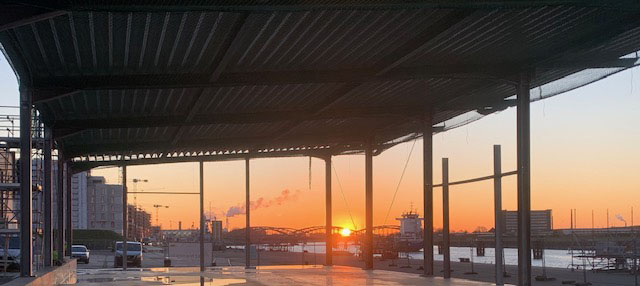
Steel construction project in Hamburg „Fire protection included“ thanks to ZINQ R30
16.03.2020 – Hamburg. Construction noise still dominates the hustle and bustle at Hamburg's Cruise Center Baakenhöft. For now, as cruise ships are soon to be handled here at Kirchenpauerkai, in the eastern HafenCity. The special feature of the single-storey terminal currently under construction: For the first time in Germany, a building with R30 fire protection will be realised through hot-dip galvanizing. The company Schienbein Industrielle Dach- und Fassadentechnik GmbH, the general contractor for the project, ventured into a first for Germany in excellent collaboration with the project stakeholders* – ZINQ was responsible for carrying out the hot-dip galvanizing in accordance with DIN EN ISO 1461.
„There is no doubt that the load-bearing structure of buildings must also be able to meet static requirements for a sufficient period in the event of a fire, not least to enable necessary rescue and operational measures by the fire brigade., explains Frank Schienbein, Managing Director of Schienbein Industrial Roof and Facade Technology GmbH.
„Following a research project concluded in 2019 at the Chair of Metal Construction at the Technical University of Munich, which demonstrated that fire resistance of 30 minutes, or R30, is achievable with unprotected, hot-dip galvanised steel structures, it became clear, not least to HafenCity Hamburg GmbH as the client, that hot-dip galvanising can satisfy three requirements simultaneously: corrosion protection, mechanical load-bearing capacity, and fire resistance of statically load-bearing steel components.“
The terminal building has a ground-floor level with an area of approximately 1,000 m², a length of 68.5 m and a width of 15.5 m, and is designed as a steel hall. Approximately 80 tonnes of steel were processed for this at ZINQ in Gelsenkirchen and transported to Hamburg.
„Working with ZINQ was, as always, service-oriented and reliable,“ summarises Guido Holtkamp from Holtkamp Stahlkonstruktionen GmbH, the steel construction company responsible for the work. „The partnership and coordination with all project partners have been running smoothly so far.“
The load-bearing structure, consisting of frame elements with supports made of HEM 240 or HEM 280 profiles and HEM 280 beams, each connected by 4 HEB 200 profiles, has already been erected on site. The inner and outer shells made of aluminium with non-combustible insulation in between are almost complete. „The effect that hot-dip galvanising improves the fire resistance of steel components, meaning the duration during which the components retain their load-bearing function in the event of a fire, can be explained by the lower emissivity of the components protected in this way,“ says Dr. Thomas Pinger, Head of Research and Development at ZINQ. „In other words: the hot-dip galvanised surface reflects thermal radiation more strongly, thereby reducing the thermal energy absorbed by the steel component, which is equivalent to a delayed heating of the components in the event of a fire.“
However, hot-dip galvanizing offers even more advantages for this location directly on the water, in particular high-quality corrosion protection during floods or when additional mechanical stress occurs as a result, for example, from debris hitting the building. In the case of a coating conventionally applied to the steel parts, a correspondingly complex system of fire and corrosion protection layers would have been required to meet the high demands. And hot-dip galvanizing also scores points from a very practical perspective. Besides being used as a cruise terminal, the hall is intended as a multi-functional venue for various events with a maximum of 700 visitors during the off-season. Here, robust hot-dip galvanizing offers another advantage. It is common practice at events to carry out installations and suspend loads such as lighting and sound equipment from the ceiling beams. Conventional fire protection coatings (intumescent paints) are often damaged by mechanical impacts during this process. The consequence is high maintenance costs.
Such mechanical damage can be ruled out on the robust, hot-dip galvanized surfaces. Not least, the hot-dip galvanizing is carried out at the factory, thus increasing the degree of prefabrication. On-site, the corrosion protection and fire protection steps are eliminated, meaning the construction time is shortened by these saved on-site work steps. The building is scheduled for completion by the Hafengeburtstag on 9 May 2020 at the latest.
Project participants:
Client: HafenCity Hamburg GmbH
General Contractor: Schienbein Industrial Roof and Facade Technology Ltd
Execution planning: Büro Wagner Architekten, Hamburg
Design author: Sellhorn Ingenieurgesellschaft mbH
Cold load calculation: Kossin + Vismann Civil Engineers
Heat Rating: hhpberlin – Engineers for Fire Protection GmbH
Corrosion protection R30: ZINQ
Steel Construction: Holtkamp Steel Structures Ltd
Salzgitter Mannesmann Steel Trading Ltd





 Deutsch
  English (UK)
  Polski
  Nederlands (België)
  Français de Belgique