
ZINQ is taking an important step towards CO2-neutral mobility by deploying all-electric tractor units from Renault Trucks for the first time.
As part of the Planet ZINQ circular business model, ZINQ continuously works on optimising its production and logistics processes in order to save energy on the one hand and exclusively use raw materials that can be returned to a cycle after use on the other. The cooperation with Renault is a further milestone on the path towards sustainable mobility and fits seamlessly into the Low-Carbon-ZINQ programme, with which the company's carbon footprint is being further reduced both in terms of the product and the process. ZINQ has already electrified its forklift truck fleet, as it has large parts of its company car fleet in Germany.
„The decarbonisation of our logistics is a central aspect for us on the path towards a more sustainable future. We are delighted to take this further step towards low-carbon mobility with Renault Trucks as our partner, says Sven Biebler, Managing Director of ZINQ Deutschland. Frederic Ruesche, Managing Director of Renault Trucks, adds: We are delighted with the partnership. ZINQ is not only a climate protection company, but is also considered a pioneer of the circular transformation. This cooperation underscores the importance of joint efforts for sustainable solutions in the transport sector. The use of the new fully electric vehicles is also accompanied by reduced noise pollution and improved air quality.
Private EV charging infrastructure for reliable transport
The two new Renault Trucks E-Tech T 4×2 tractor units will in future be deployed at the sites in Landsberg near Halle and in Gelsenkirchen. On the defined routes, the trucks can be supplied entirely with green electricity via ZINQ's own charging infrastructure – a holistic approach to sustainable solutions. For this purpose, the aforementioned sites have been equipped with hyperchargers, which enable fast and efficient charging of the trucks directly on the company premises. This ensures that the fully electric vehicles are reliably available for daily use entirely in the service of the customer – independently of the public charging network for heavy-duty electric vehicles.
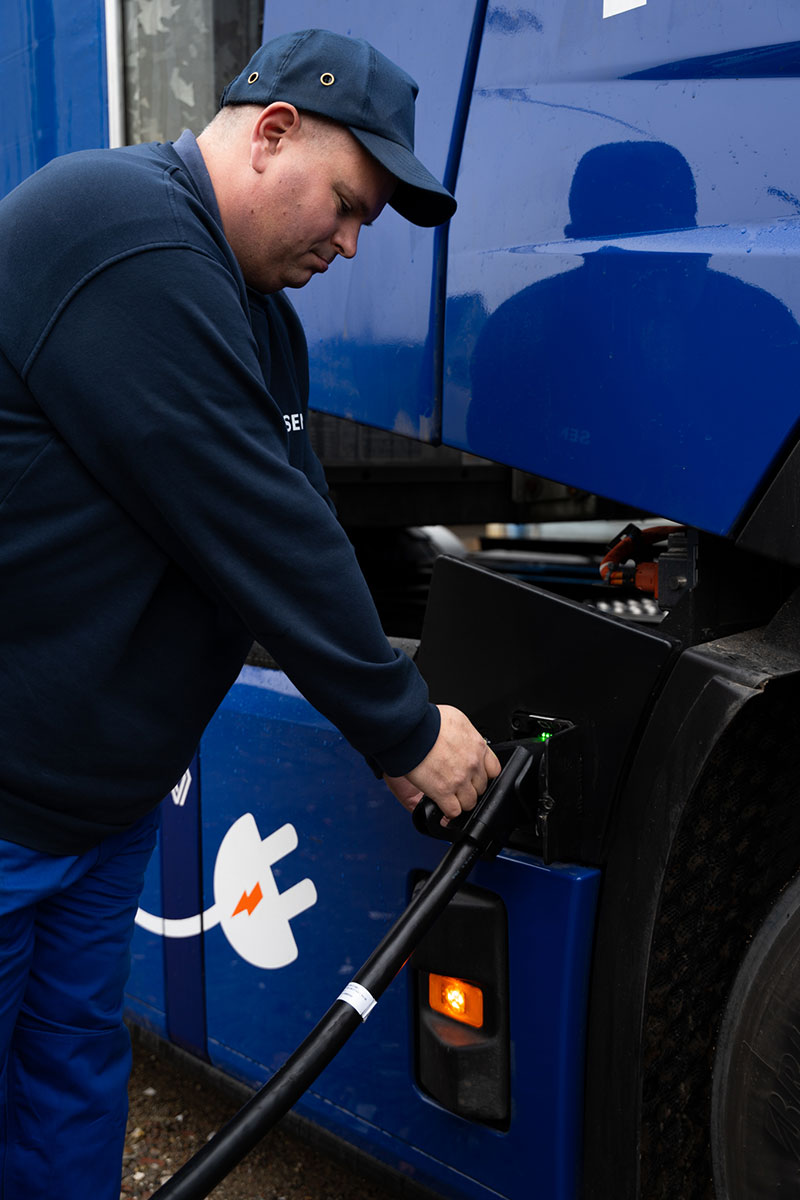




 ZINQ/Carsten Paul
 Deutsch
  English (UK)
  Polski
  Nederlands (België)
  Français de Belgique