
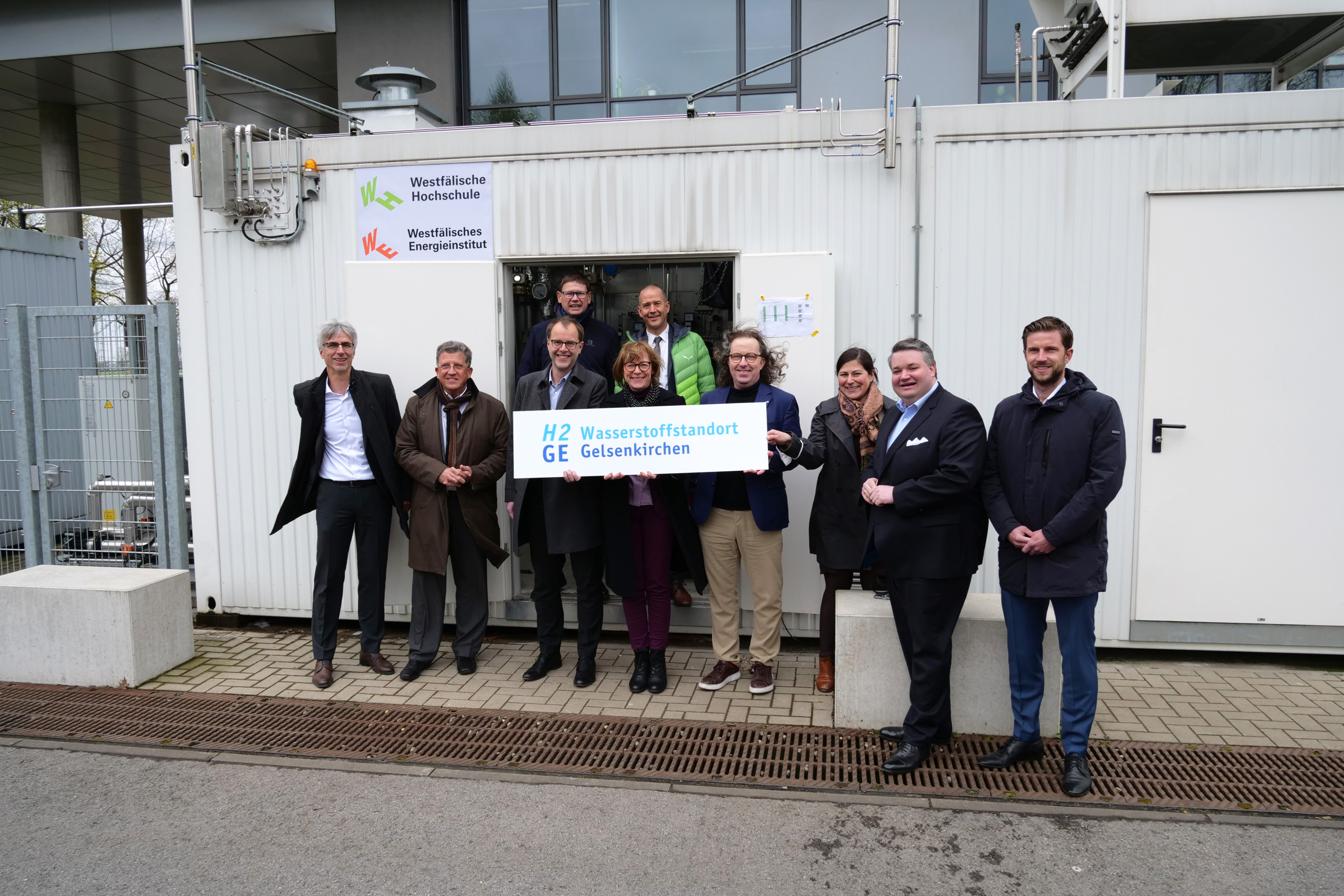
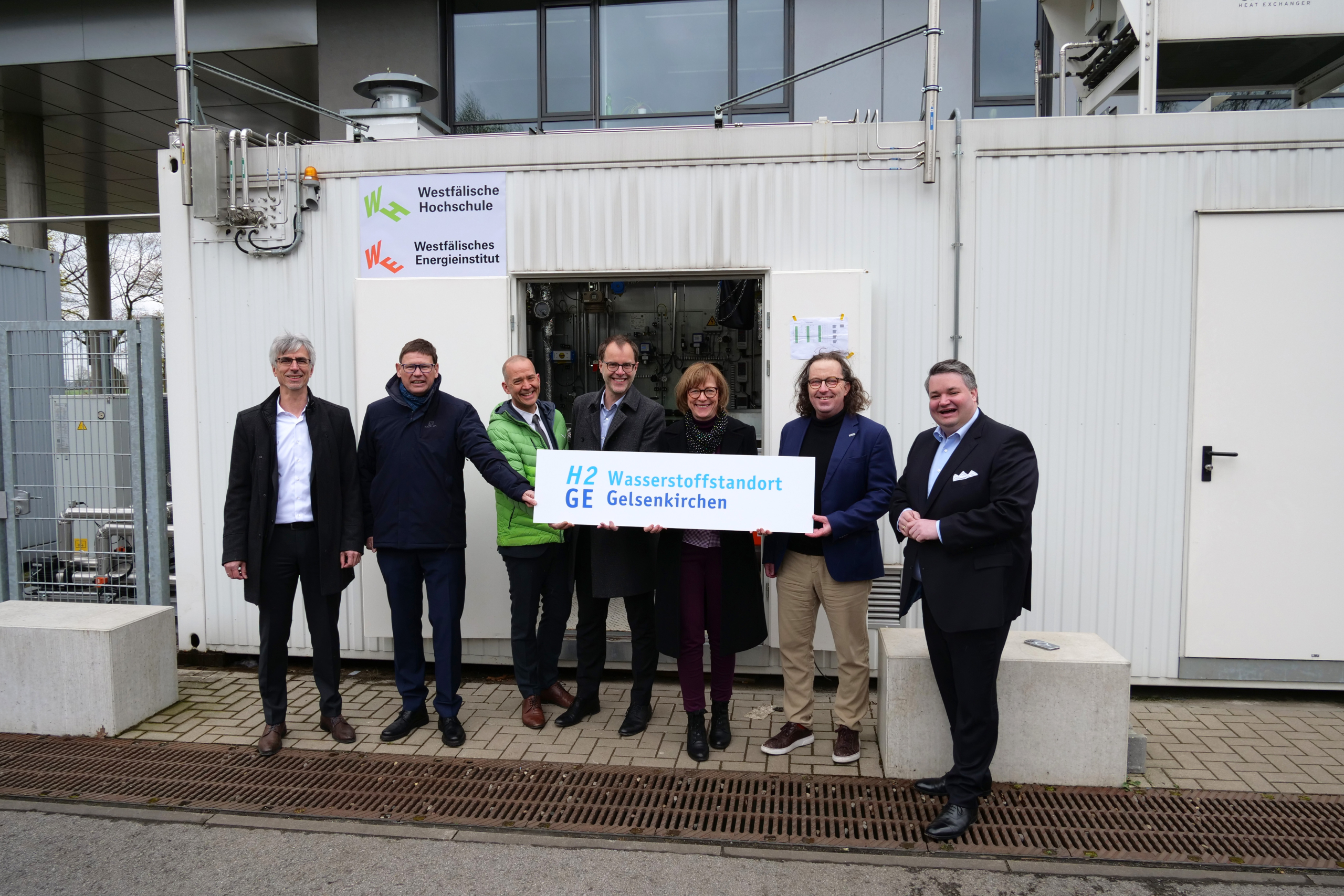
Gelsenkirchen, 1 April 2022 – The energy city of Gelsenkirchen is taking off – with project plans for the research and use of green hydrogen in industry and the SME sector. To this end, the leaders of the city, university, and business community launched the initiative „H2GE – Hydrogen Location Gelsenkirchen“ at the Westfälische Hochschule today, presented three pilot projects, and invited further stakeholders to join the initiative. The three projects are intended to drive forward the transformation into a green industrial city with hydrogen in key areas:
- Building on the long-standing hydrogen expertise of the Westphalian University, the „H2 Solution Lab“ aims particularly to pave the way into the hydrogen economy for small and medium-sized enterprises in the region – through the joint development of technical solutions and the training of academic specialists as part of a new Master's degree programme.
- The testing of hydrogen technologies on an industrial scale and the further training of skilled professionals are the focus of the „Hydrogen Industrial Research and Training Center (H₂iRTC)“, which is to be established at Uniper's power plant site in Gelsenkirchen-Scholven.
- In the already-launched „Climate Port Gelsenkirchen“, 17 companies want to develop a blueprint for the climate-neutral transformation of an entire industrial and logistics area. To decarbonise their process heat, the energy-intensive companies are striving for rapid connection to a piped supply of green hydrogen.
Lord Mayor Karin Welge welcomed the commitment and invited further stakeholders to participate: „Climate change and the Russian President's war in Ukraine require an accelerated transformation of our energy supply – away from fossil fuels and towards green energy. Hydrogen is the key technology for many industrial sectors. To maintain and expand our industrial jobs, we are therefore driving this change forward together. The projects presented today are a powerful starting signal for this.“ The City of Gelsenkirchen supports its partners in submitting the projects to suitable funding programmes and has commissioned the Wissenschaftspark (Science Park) with coordinating the initiative.
Uniper power plant manager Dr Lars Wiese is delighted about the alliance of stakeholders and emphasises the opportunities presented by transforming the Scholven power plant site: „Our future project H₂iRTC is an important step towards maturing technologies that will enable the large-scale decarbonisation of industry. We remain loyal to the region by leveraging the site's synergies and simultaneously making it fit for the future.“
Prof. Dr. Bernd Kriegesmann, President of the Westphalian University of Applied Sciences, sees real opportunities for new impetus in the region from the initiative: „It’s no longer enough to talk about what needs to be done; it’s about moving from defence to offense now and actually taking action. That’s what we want to achieve with the H2-Solution-Lab: shaping the future with concrete contributions to solutions for sustainable energy supply and creating prospects for new value creation and jobs in the region.“
Lars Baumgürtel, Managing Director of ZINQ GmbH & Co. KG and spokesperson for the Klimahafen Gelsenkirchen initiative, highlights the advantages of Gelsenkirchen as a hydrogen location: „With its existing electricity and gas infrastructure and numerous players with many years of experience in the research, production, transport and use of hydrogen, Gelsenkirchen already has an ideal starting position for a swift entry into the hydrogen economy. The projects presented today make precisely this advantage their own. They cover various facets of the necessary transformation and can mutually promote each other.“
„The H2GE initiative is an excellent example of how individual projects can be meaningfully brought together through early, trusting collaboration between stakeholders. This should be an incentive and a benchmark for establishing further innovation projects in the region. When implementing the Emscher-Lippe hydrogen roadmap, as well as on other topics such as the circular economy, we need agile structures for the development and implementation of innovative project plans,“ said Dr. Jochen Grütters, Head of the Emscher-Lippe site at the IHK Nord Westfalen.
The pilot projects in detail:
H2 Solution Lab
An H2-Solution-Lab is to be established at the Westfälische Hochschule, where hydrogen system components and hydrogen plant technology will be designed, built, tested, and validated. The work in the highly flexible development and testing centre will cover complete hydrogen generation systems, from valves, electrolysers, fuel cells, and compressors to storage systems, as well as hydrogen utilisation systems, which will particularly support the transition of medium-sized companies to a hydrogen economy. Utilisation scenarios in areas such as fuelling technology, process heat generation, and heating supply in residential districts will be addressable here. Due to the discernible demand for medium-performance hydrogen system technology, which is currently only addressed by very few other players, the H2-Solution-Lab will handle hydrogen systems and their components up to a performance level of 1 MW. The application-oriented scientific expertise of the researchers at the Westfälische Hochschule, who have been successfully involved in developments in the field of hydrogen technology, particularly with high-pressure electrolysis systems, for years, will be combined with the challenges and opportunities of the region's companies through this focus. This transfer-oriented symbiosis will ensure that projects implemented in the H2-Solution-Lab in the future can make valuable contributions to the challenges of the energy transition, thereby creating and preserving value and jobs in the region.
Hydrogen Industrial Research and Training Centre (H₂iRTC)
The project is intended to enable the transformation of the current Gelsenkirchen-Scholven coal-fired power station site into an innovation hub for hydrogen technologies. To this end, an extensive testing infrastructure is to be created that makes it possible to pilot, test and further develop large-scale hydrogen technologies in an industrial environment. For the four application areas of hydrogen production, storage, distribution and utilisation, various test rigs with connection facilities will be set up, differing primarily in their media supply. In total, hydrogen, oxygen, nitrogen, natural gas, water, heat and electricity will be able to be supplied and offtaken – which establishes the supra-regional unique selling point of the H2iRTC as an industrial real-world laboratory for hydrogen. Furthermore, the H2iRTC is intended to contribute to the development of skilled workers in the Emscher-Lippe region and beyond. Practical training through hands-on work at the test rigs is intended to enable qualified and certified continuing education. Through this application-oriented further training, occupational fields that will have to deal with hydrogen in the future will be qualified and existing jobs secured. A pilot project is expected to launch as early as summer 2022. For this purpose, Uniper is cooperating with KWS Energy Knowledge eG, the IHK Nord Westfalen (North Westphalia Chamber of Commerce and Industry) and the DVGW (German Technical and Scientific Association for Gas and Water).
Gelsenkirchen Climate Port
The initiative, which began in mid-2021 with companies from the Gelsenkirchen city harbour and its immediate surroundings, supported by the city, Wissenschaftspark, and IHK Nord Westfalen (Chamber of Industry and Commerce North Westphalia), now comprises 17 companies from a wide range of sectors. The common goal is a rapid transformation to climate neutrality through independent action and, where this is insufficient, a joint commitment to creating suitable framework conditions. The pilot project is the decarbonisation of process heat in energy-intensive companies. With an annual heat requirement of approx. 500,000 megawatt-hours (MWh), the corporate cluster has a unique position nationwide and is prototypical for the industrial SME sector. To decarbonise process heat, the initiative calls for the extension of the GetH2 hydrogen pipeline, which arrives from the north in Gelsenkirchen-Scholven in 2024, into the city harbour. Alternatively, the initiative is currently examining the technical and economic feasibility of building a large-scale electrolyser for local hydrogen production near the "Klimahafen" (Climate Harbour) with several interested parties from the energy industry. In the area of mobility, the initiative is currently determining the demand and feasibility for a tri-modal hydrogen refuelling station for the fuelling of lorries, rail vehicles, and inland vessels.
Further information on the H2GE initiative and the individual projects can be found on the website that went live today. www.hydrogen-gelsenkirchen.de




 Deutsch
  English (UK)
  Polski
  Nederlands (België)
  Français de Belgique