• Specialist information on
    Hot-dip galvanising

Hot-dip galvanising is recognised as the best method of protecting steel against corrosion.

Naturally, you expect the ZINQ experts to provide optimum corrosion protection for your steel project. However, for optimum results, it makes sense to coordinate your steel product as early as the planning phase.

What generally needs to be considered when designing materials? Can hot-dip galvanised components be processed? Our Knowledge section provides comprehensive answers to these and other questions relating to corrosion protection.

If you have any further questions, our ZINQ experts will be happy to advise you.
Knowledge about hot-dip galvanising

Technical basics: Hot-dip galvanising

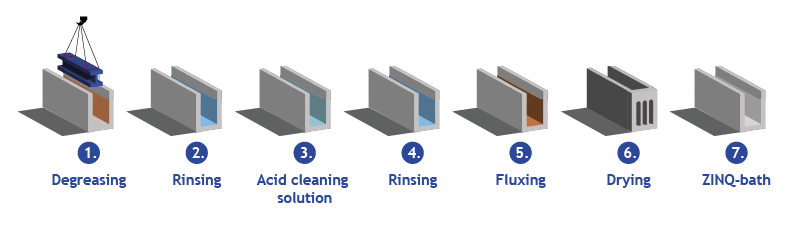
The galvanising process is divided into several steps, which are carried out one after the other.

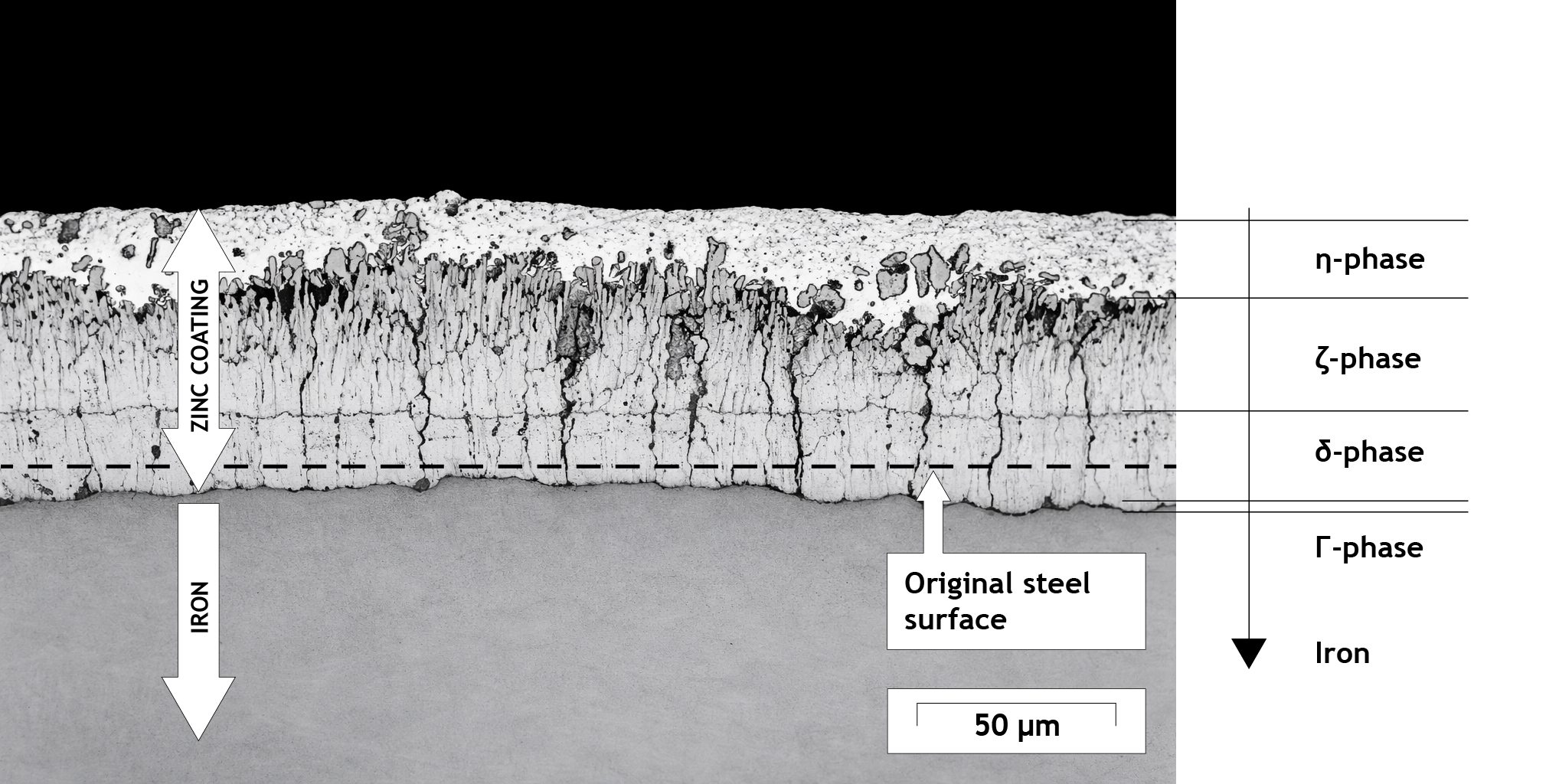
The reaction between the steel and the molten zinc leads to the formation of a multiphase, solid iron-zinc layer that is highly resistant to external mechanical and corrosive stresses.

  • The iron-zinc phases have a higher hardness than the base material.
  • The removal rates of the zinc layer are low even under high corrosive loads.
  • Due to the cathodic protective effect of zinc, no steel corrosion occurs even if the zinc coating is damaged (self-healing effect).

Standards:

DIN EN ISO 1461 „Zinc coatings applied to steel by hot-dip galvanising“

DIN EN ISO 14713 Protection of iron and steel structures against corrosion

DIN EN ISO 10684 „Fasteners - Hot-dip galvanising“

Guidelines:
„Guideline for the production of hot-dip galvanised screws“, Deutscher Schraubenverband „Recommendations for avoiding cracking of hot-dip galvanised steel structures“, Deutscher Schraubenverband & Industrieverband Feuerverzinken „Hot-dip galvanising of load-bearing steel components“, DASt Guideline 022

Mechanical effects

The component is heated to approx. 450 °C, which has the following effects on the base material:

  1. Expansion of the material by approx. 4.5 mm/m
  2. Temporary reduction in the strength of the steel by about 1/2 compared to the value at room temperature

Uneven heating/cooling of the component

  • the component height during the insertion or extraction process and
  • regarding the material thickness during dwelling in the melt or cooling in air. The resulting differential thermal expansion and contraction can lead to constrained stresses or unwanted component distortion. To minimise these effects, the thickness differences of the materials used should therefore be kept as small as possible (tmax/tmin < 2,5.)

In addition, the process heat causes a reduction in production-related residual stresses (e.g. from welding or straightening a component), which can then manifest themselves as distortion after the galvanising process. To minimise this effect, it is therefore recommended that production is as free of residual stresses as possible (see also „Design > Residual stresses and distortion“).

Material selection and processing of the material

The steel materials to be galvanised must meet the requirements of DIN EN 10025 and be suitable for hot-dip galvanising due to their chemical composition and mechanical properties. Steel materials in accordance with standards other than DIN EN 10025 and with other properties should only be supplied on request and after testing by the plant. As the silicon (Si) and phosphorus (P) content of the steel has a decisive influence on the galvanising result (see also point „Material selection and processing of the material > Steel with special composition“), we recommend the use of steels in accordance with DIN EN ISO 14713-2, Table 1 (simplified guideline for the composition of steel).

Hot-dip galvanising of castings is not usually a problem. The only exceptions are old castings, for example for restorations. In this case, we recommend first carrying out tests to determine the suitability for galvanising.

Certain elements in the steel, in particular silicon (Si) and phosphorus (P), influence the reaction between the iron and the molten zinc. Therefore, certain steel compositions can produce more uniform coatings in terms of appearance (shiny or matt), thickness and evenness (smoothness) than others.

If there are special requirements for the galvanising appearance, the following limit values must be observed for the steel composition in accordance with DIN EN ISO 14713-2, Table 1:
– ≤ 0.03 % Si and ≤ 0.02 % P, whereby Si + 2.5 P ≤ 0.09 % must also apply, or for cold-rolled steels Si + 2.5 P ≤ 0.04 % or
– ≥ 0.14 % If bis ≤ 0.25 % If Additionally, the aluminium content should not exceed 0.035 %.

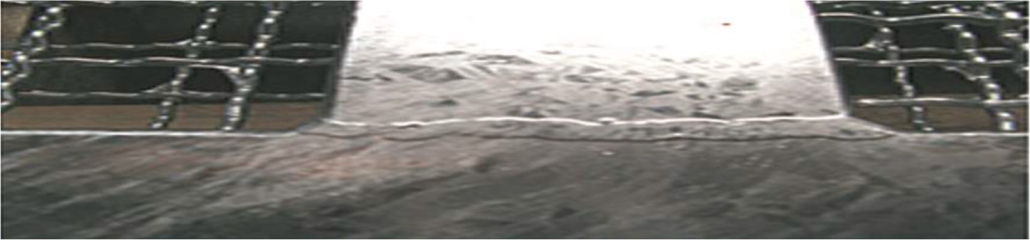
Due to different materials in the welding filler and base material, different reactions between zinc and steel, or zinc and the welding filler material, can occur. As a consequence, the weld seam may differ visually from the base material. We recommend using welding filler materials with a maximum silicon content of 0.45 %. Additionally, the aluminium content should not exceed 0.03 %.

Hot-dip galvanising of brazed joints is possible without any problems. However, care must be taken to ensure that flux residues, oxide layers etc. are removed after the soldering process. Soft soldering is not recommended for parts that are to be hot-dip galvanised, as the soldered joint may come loose due to the molten zinc temperature of 450 °C.

Cold forming introduces residual stresses into the component, which can be released during galvanising and then lead to distortion of the structure. Depending on the degree of cold forming, the deformation capacity of the steel is also affected (ageing). In this case, the effect of the molten zinc can have negative consequences, including damage to the component. The permissible degree of cold forming depends on the grade of material used. If in doubt, the safe galvanisation of cold-formed parts should be checked by means of a test galvanisation.

Constructive design

All workpieces are suspended from crossbars and thus pass through the galvanising process. One hole is usually sufficient for small parts, while larger parts require at least two holes for hanging. The necessary holes or eyelets can usually be arranged in such a way that they do not interfere with the visible side. Prior consultation with the galvanising shop is recommended.

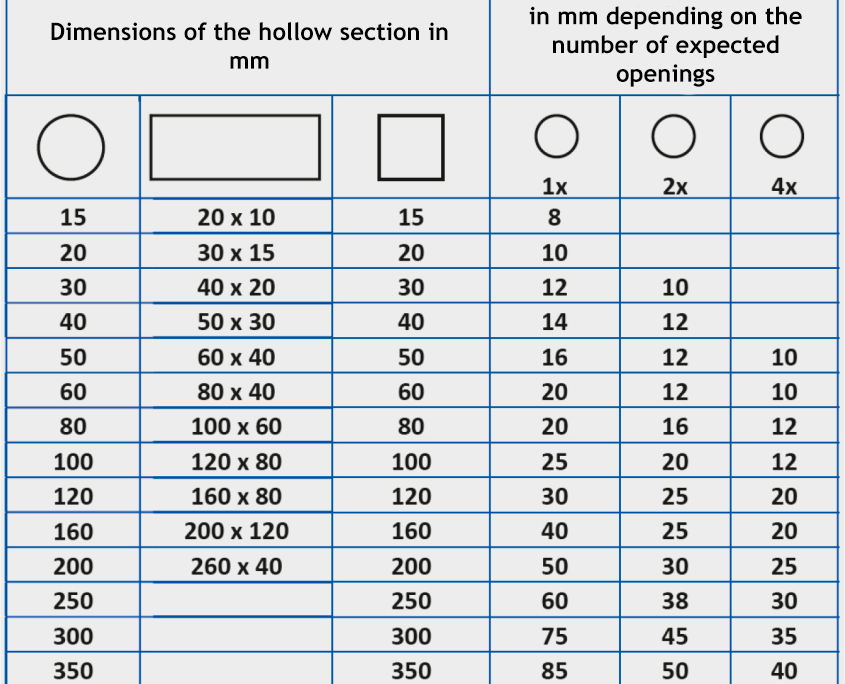
With hollow profiles, it is important to ensure that there are a sufficient number and size of openings to allow the pre-treatment media to flow in and out and the air to escape. If there are no openings, the heated air builds up a very high internal pressure, which can lead to the hollow section exploding! According to DIN EN ISO 14713, the following recommendations regarding the size and number of openings are given for small and medium-sized hollow sections:

NOTES:

The normative recommendations do not refer to a length. We therefore recommend that the adjacent specifications for horizontal elements be regarded as a value/m. For larger cross-sections, the openings should be approximately 25 % of the diameter of the hollow profile.

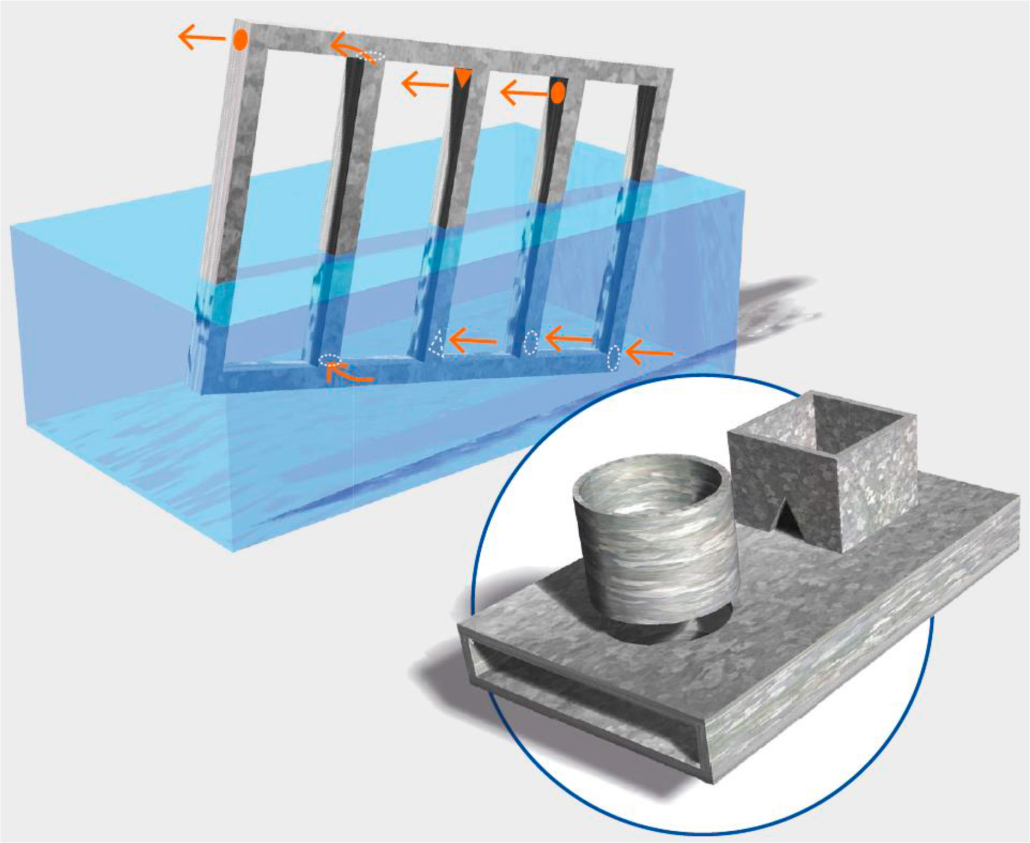
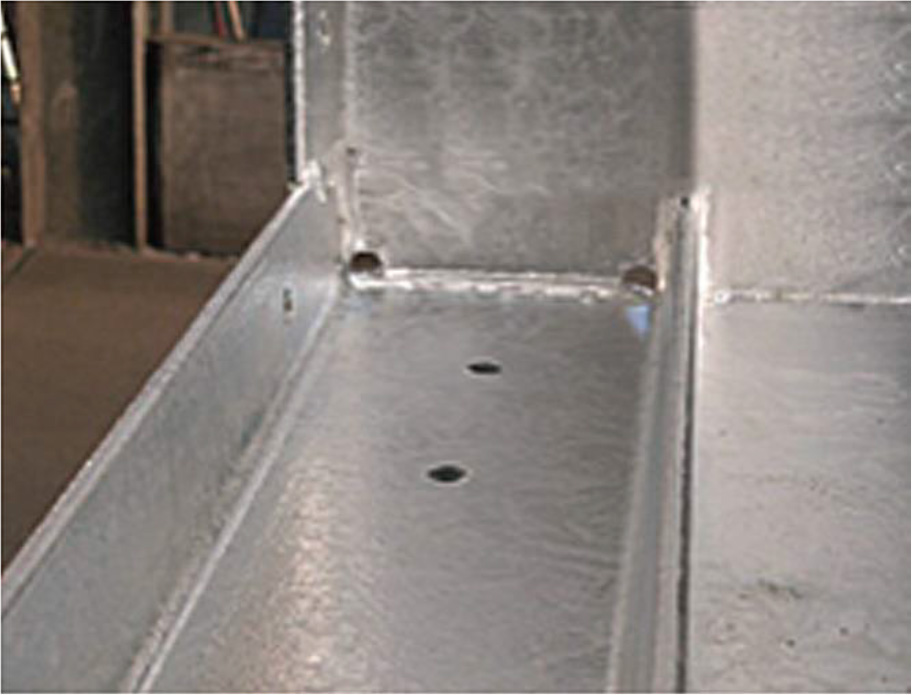
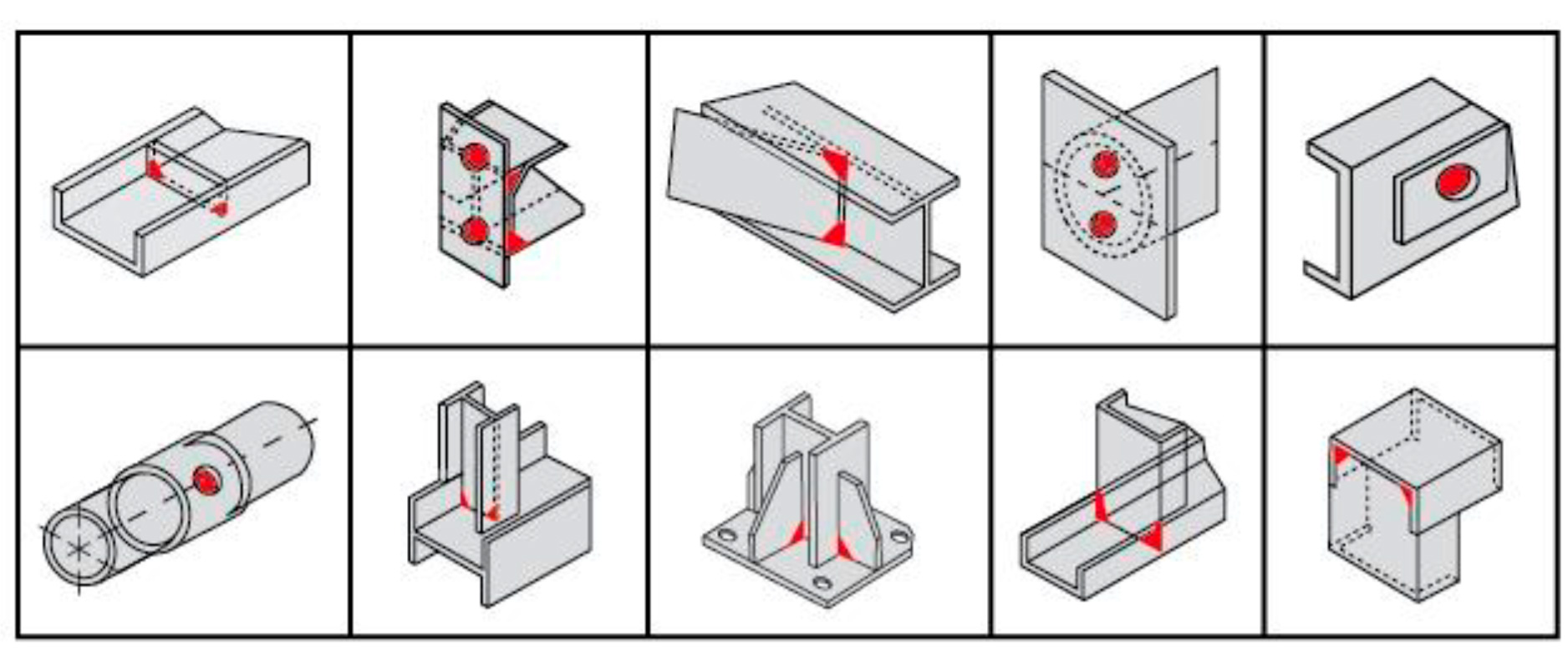
Scooping parts or air pockets occur, for example, if the necessary openings are not in the right place. This can lead to unwanted accumulations of zinc or defects. The openings should be arranged in such a way that the trapped air can escape upwards when a component is immersed and the zinc can drain downwards when it is removed.

Notches are a design option for creating recesses, ventilation holes or zinc inlet and outlet openings. Some recommendations for the arrangement of inlet and outlet openings are summarised below:

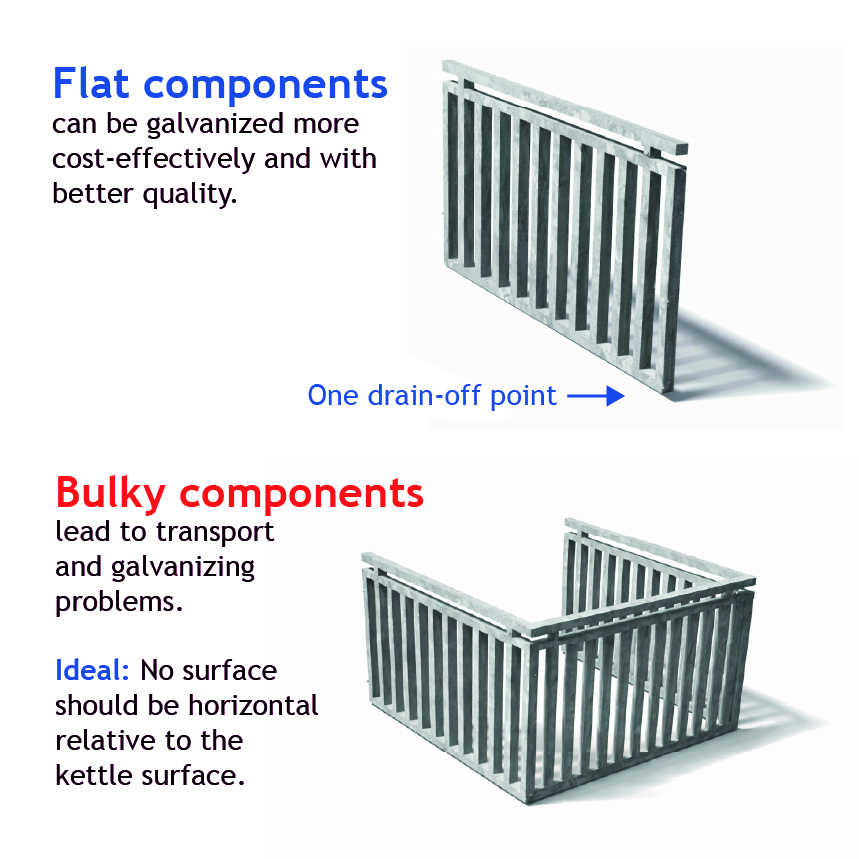
Bulky parts can lead to transport and galvanising problems, while flat components can be galvanised better and more economically.

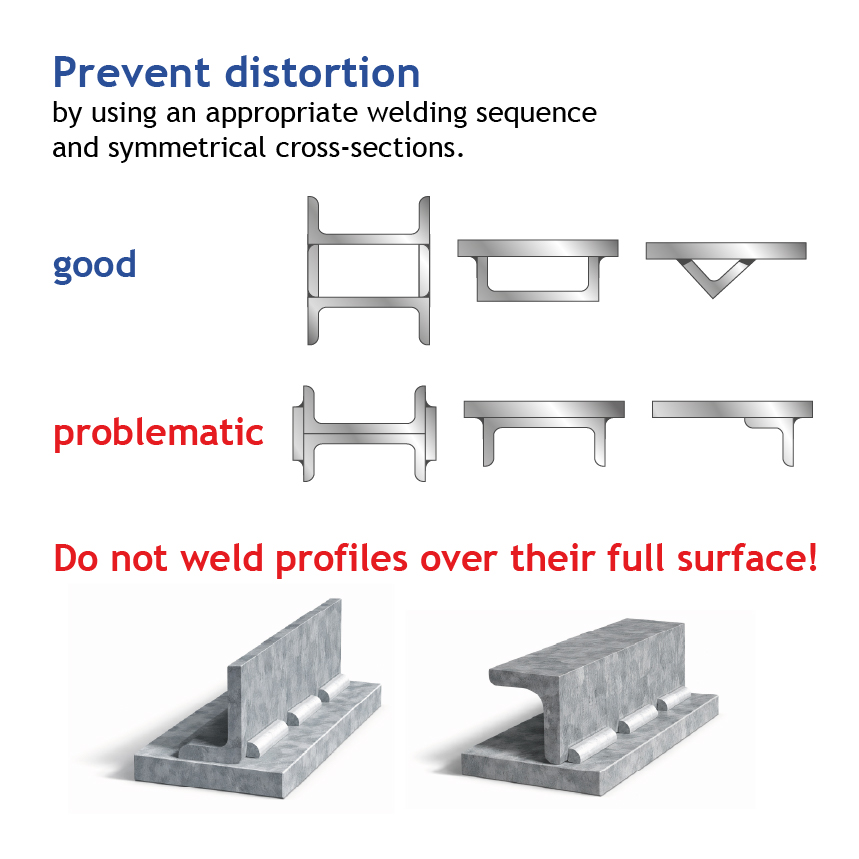
To reduce/avoid residual stresses and unwanted distortion from the galvanising process, the following recommendations should be observed during design and production:

  • Minimisation of production-related residual stresses (e.g. through a suitable welding sequence),
  • Avoid jumps in stiffness/constructive notches (differences in thickness as small as possible),
  • Select cross-sections that are as symmetrical as possible,
  • Take thermal expansion into account (e.g. beading in filler panels).

Surface condition on delivery

The surface condition of the starting material influences the quality of the zinc coating. As some material-related defects and production-related impurities cannot be removed by the pre-treatment media and can lead to incorrect galvanising, it is important to consider a few points regarding the surface quality of the black material during production. The steel surface should be untreated on delivery. Changes to the pure steel surface, e.g. through flame cutting or the application of release agents or primers, which are carried out by the steel manufacturer or processor or in other ways outside the area of responsibility of the galvanising company, can influence the reactivity of the steel. This can result in zinc coatings that deviate from the formation otherwise to be expected due to the chemical composition under normal galvanising conditions, particularly with regard to the thickness of the zinc coating (see also „Material selection and processing of the material > Steel with special composition“) and may be below the minimum thickness required by the standard.

Silicones, e.g. in welding release agents or oils, must never be used on material that is to be hot-dip galvanised! Even minor contamination, e.g. a contaminated workbench, contaminated gloves or contaminated packaging material (beams), is sufficient to impair the desired galvanising result. Weld release agents or gun sprays should be used very sparingly on the surface to be galvanised. Many of the agents on offer burn in approx. 5 - 10 mm next to the seam. Removal is not possible chemically, by degreasing or pickling. Coolants and lubricants used during sawing, drilling or punching sometimes leave a film on the surface of the workpieces to be galvanised that is very difficult to remove chemically. As a result, the hydrochloric acid used during pickling cannot reach the rusted or scaled metal surface. This results in non-galvanised defects.

Stickers and labelling leave residues on the steel surface that are not removed by the pre-treatment liquids. As a result, incorrect galvanising will occur in these areas if the stickers, labels and any adhesive residues are not removed beforehand. This is the responsibility of the customer.

Scratches from sheet metal processing, bending benches, sheet metal shears and scribing needles, as well as grinding marks, are clearly visible even after hot-dip galvanising. Rolling defects can lead to localised thickening (pimples).

Hot-dip galvanising of blasted material is not a problem. However, it is important to ensure that there is no excessive roughness caused by too coarse an abrasive. Otherwise, a rough surface must be expected even after hot-dip galvanising. The layer thickness is greater. Blasted materials should also be checked to ensure that they have not already been galvanised and need to be dezincified before any new treatment.

Reworking

In practice, small defects, assembly-related spalling or ungalvanised areas may occur during subsequent processing (cutting, welding, drilling) of a component. Such areas up to a size of 10 cm2 (according to DIN EN ISO 1461) can be repaired without further ado, whereby the following points must be observed:

  • According to DIN EN ISO 1461, the coating thickness at the repair point must be at least 100 µm.
  • Zinc sprays should not be used as they have a high aluminium content, which provides a good appearance but only very limited corrosion protection (layer build-up per spray coat max. 10 μm)!
  • Instead, zinc dust paint with at least 90 % zinc content in the pigment should be used.
  • Before coating, the defective area must be sufficiently cleaned and dried (standard cleanliness SA 2 1⁄2).
  • Another suitable repair method is thermal spraying, which is regulated in DIN EN ISO 2063. We recommend the zinc dust paints LZ 09, LZ 50 and LZ 99 available in our factories for repairs. As an alternative to repairing with paint, we recommend ZINQ® Fix.

Welding should preferably be carried out before hot-dip galvanising. If welding is carried out after hot-dip galvanising, the coating should be removed locally in the weld seam zone before welding to ensure a high-quality weld.

Processing after hot-dip galvanising (in this case welding) is generally associated with a deterioration or destruction of the corrosion protection.

Corresponding additional reworking is required to restore the corrosion protection. During welding, the zinc that has not been completely removed burns on the surface. Note: Zinc burns with a green flame at over 907 °C.

Welding of galvanised parts must be carried out in accordance with current health and safety regulations using suitable ventilation.

We recommend the products LZ 98 and ZINQ® Free available at our ZINQ locations to avoid localised zinc absorption.

As a rule, hot-dip galvanised structures are joined together using screw or bolt connections. It should be noted that in this case the use of hot-dip galvanised fasteners is mandatory in accordance with DIN 18800 - 7 (execution of steel structures).

The zinc coating can flake off during sharp-edged bending, and drilling can result in at least small defects as bare cut edges. If the damage is unavoidable, it should at least be repaired with a good, high-zinc zinc dust paint as recommended under „Reworking > Reworking“.

Do you have any questions?

Our master locksmiths, steel construction engineers and technicians will be happy to help you - to clarify technical questions, for training in the
corrosion protection, even including support with building inspections.

If required, we will be happy to advise you on site at one of our ZINQ locations or at your company.

Tel. 0800 9403020 info@zinq.comTel. +32 11 510 210 info@zinq.be

Search