
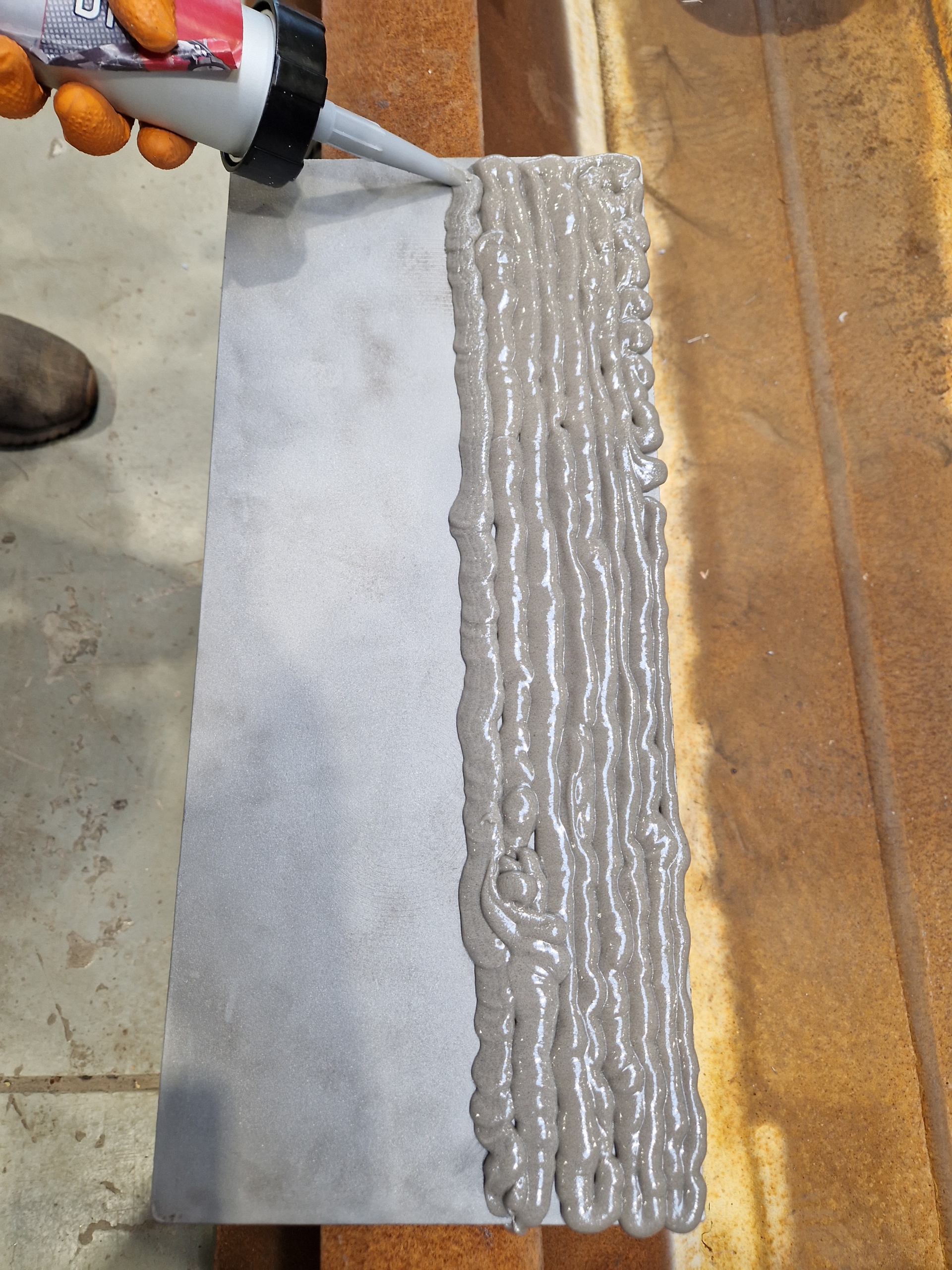
Piece-welded steel has been used in the metalworking industry for decades and is renowned for its corrosion resistance, durability and reliability. For a long time, welding and bolting of piece-welded components was considered the standard. However, new research findings reveal exciting alternatives: Bonding piece-welded steel also works safely and reliably. This joining technique opens up new possibilities for optimized designs, including the avoidance of thermally induced stress (as in welding), high-quality aesthetics (by avoiding screw-induced stress), and/or new combinations of materials.
Several studies from Germany and Europe have shown that galvanized components can be permanently and highly robustly bonded when the surface preparation is correct and the adhesive is optimally matched to the zinc coating. Not only pure adhesive bonds were investigated, but also hybrid bonds in which adhesive was combined with mechanical joining techniques such as clinching or screws.
The results are clear: In practical tests, especially when considering outdoor weathering, the glued and hybrid-sewn samples achieved high shear strength, ensuring permanent and efficient connections.
Various zinc coating processes were investigated, such as conventional duroZINQ batch coating or microZINQ thin-film coating. It was shown that the type and structure of the zinc layer have an influence on the bond strength of the connection. In particular, the composition of the zinc-iron phases in the coating had an effect on the tensile strength of the adhesive.
Hybrid connections with adhesive and mechanical fasteners (screws) that were tensioned with a defined preload force were also thoroughly investigated. Here it was shown that by combining the two joining techniques, a significant increase in load capacity could be achieved compared to the individual joining components, while maintaining increased durability.
The correct surface preparation is crucial for all types of bonding. For zinc coatings, this includes light sanding or chemical cleaning and/or activation. It is essential to carefully coordinate the type of zinc coating, surface preparation, and adhesive selection to achieve maximum load-bearing capacity and a durable bond.
For the metalworking industry, this means that gluing can in the future be an additional or alternative joining technique. Especially where welding seams damage corrosion protection layers or where fasteners visually interfere with aesthetics, this opens up new possibilities.
 ZINQ_Volker_Beushausen
 Deutsch
 English (UK)
 Polski
 Nederlands (België)