
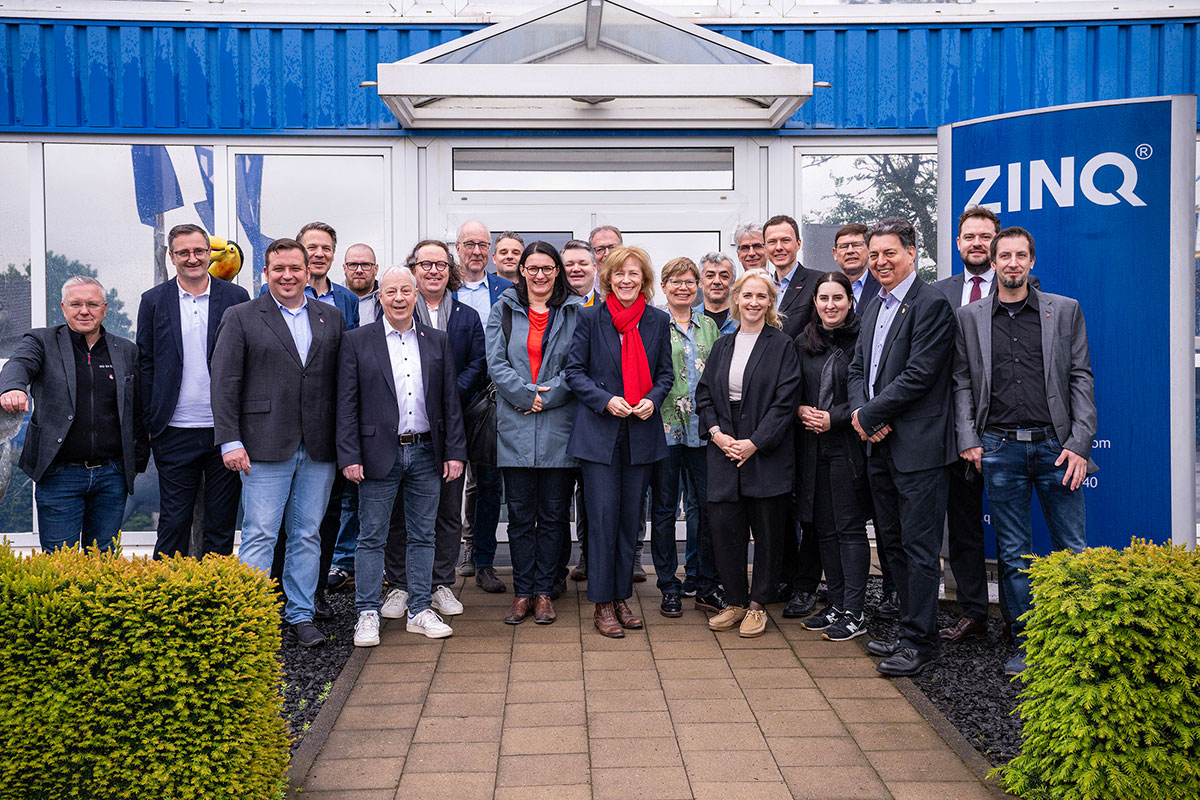
Only by joining forces can the transformation in Gelsenkirchen be successfully shaped: under the title „Transformation in Gelsenkirchen“, representatives of the German Trade Union Confederation (DGB) for the Emscher-Lippe region, the Münster Chamber of Trades, the North Westphalia Chamber of Commerce and Industry and WiN Emscher-Lippe GmbH are setting a joint example for the transformation of the region at ZINQ. In doing so, ZINQ is leading by example.
Together with companies, their works councils and regional and federal members of parliament, the representatives of the four institutions discussed the challenges and opportunities of the energy transition, the circular economy and climate protection. It became clear that skilled workers from the trades and industry play a key role.
The participants called on politicians to create the necessary framework conditions as quickly as possible for the energy transition, for a functioning circular economy and to combat the skills shortage. „Only together can we successfully shape the transformation in Gelsenkirchen,“ was the conclusion of the event. This required continued and closely coordinated cooperation between all actors.
Lars Baumgürtel, Vice-President of the IHK Nord Westfalen and Managing Partner of ZINQ, emphasised: „Transforming our industry circularly means manufacturing products using low-carbon energy and reusing all raw materials used in the products over and over again in closed material cycles.“
Ahead of the European elections, the IHK Nord Westfalen is making it clear that the issue is not about individual solutions or sectors, but about creating optimal framework conditions so that as many companies as possible can innovatively shape their individual transformation path. These prerequisites include a secure supply of wind or solar power and green hydrogen, as well as the creation of market conditions in which circular products can succeed in the market. „It is about fair framework conditions for competitive sustainability and the avoidance of shortages of raw materials and energy. How circular transformation, innovations, investments and competitiveness are interconnected is demonstrated in our region by the Klimahafen Gelsenkirchen and the corporate network Transform to Zero, with the goal of manufacturing circular and thus climate-neutral products,“ says Baumgürtel.
Mark Rosendahl, regional manager of the DGB region, is satisfied with the outcome of the meeting: „Together with our member trade unions, the IHK, HWK and WiN Emscher Lippe, as well as the city of Gelsenkirchen and local businesses, we have an opportunity to move the region forward and be successful. Today's exchange has helped to show decision-makers from the state parliament and the Bundestag how the energy transition and transformation can be implemented as quickly as possible.“.
Thomas Harten, Deputy Managing Director of the Münster Chamber of Skilled Trades, stated: „Craftspeople are drivers of innovation, local advisors and problem solvers, and ultimately ensure professional implementation and maintenance. However, to achieve the energy and climate protection goals, the measures must be implemented even more swiftly. In addition to federal and state policy measures, this requires, above all, local activities within the municipalities. Gelsenkirchen and the skilled trades sector must work together even more closely to ensure the sustainable success of the energy transition.“
Dr Babette Nieder, Managing Director of WiN Emscher-Lippe GmbH, also sees the transformation as an opportunity for the region: „Day-to-day operations will determine whether the transformation is successful and whether the goals of ‚zero emission, zero pollution and zero waste‘ offer companies in Gelsenkirchen and the Emscher-Lippe region an economic outlook, thereby creating good jobs and new value chains.“




 Deutsch
  English (UK)
  Polski
  Nederlands (België)
  Français de Belgique